
Mar 14, 2026
How Misleading Campaigns Hurt Donor Trust
Trust is the foundation of successful fundraising, but misleading campaigns can break this bond, driving donors away. Key takeaways:
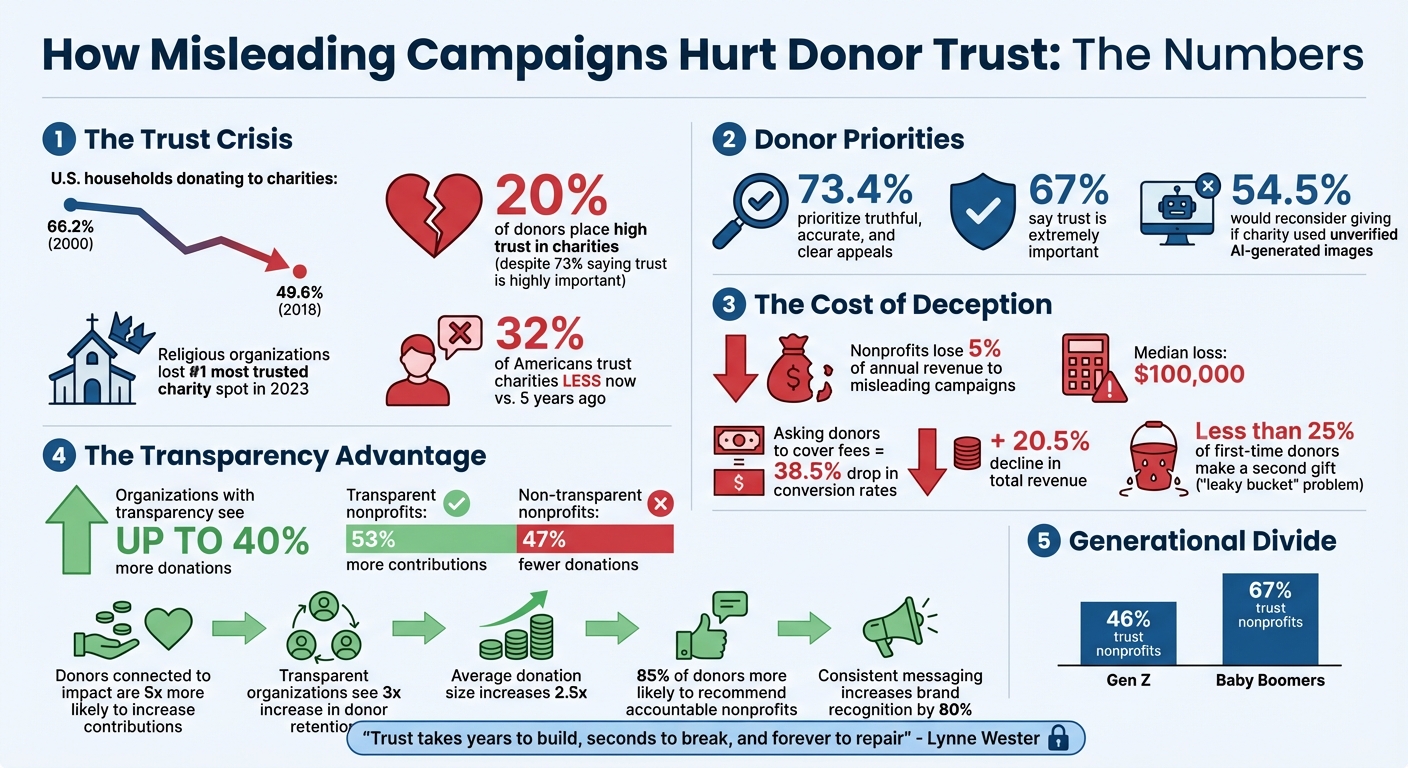
- Donor trust is declining: Religious organizations lost their spot as the most trusted charity category in 2023, and U.S. households donating to charities dropped from 66.2% in 2000 to 49.6% in 2018.
- Transparency boosts donations: Organizations that prioritize clear communication see up to 40% more contributions and stronger donor loyalty.
- Misleading practices erode confidence: Hidden fees, vague claims, and unclear donation processes leave donors feeling deceived.
- Regulatory risks: Deceptive campaigns can lead to fines, lawsuits, and even the loss of tax-exempt status.
Nonprofits must focus on honest communication, clear financial disclosures, and ethical fundraising to rebuild trust and secure long-term support.
How Misleading Campaigns Impact Donor Trust: Key Statistics
How Misleading Campaigns Damage Donor Trust
What Counts as a Misleading Campaign
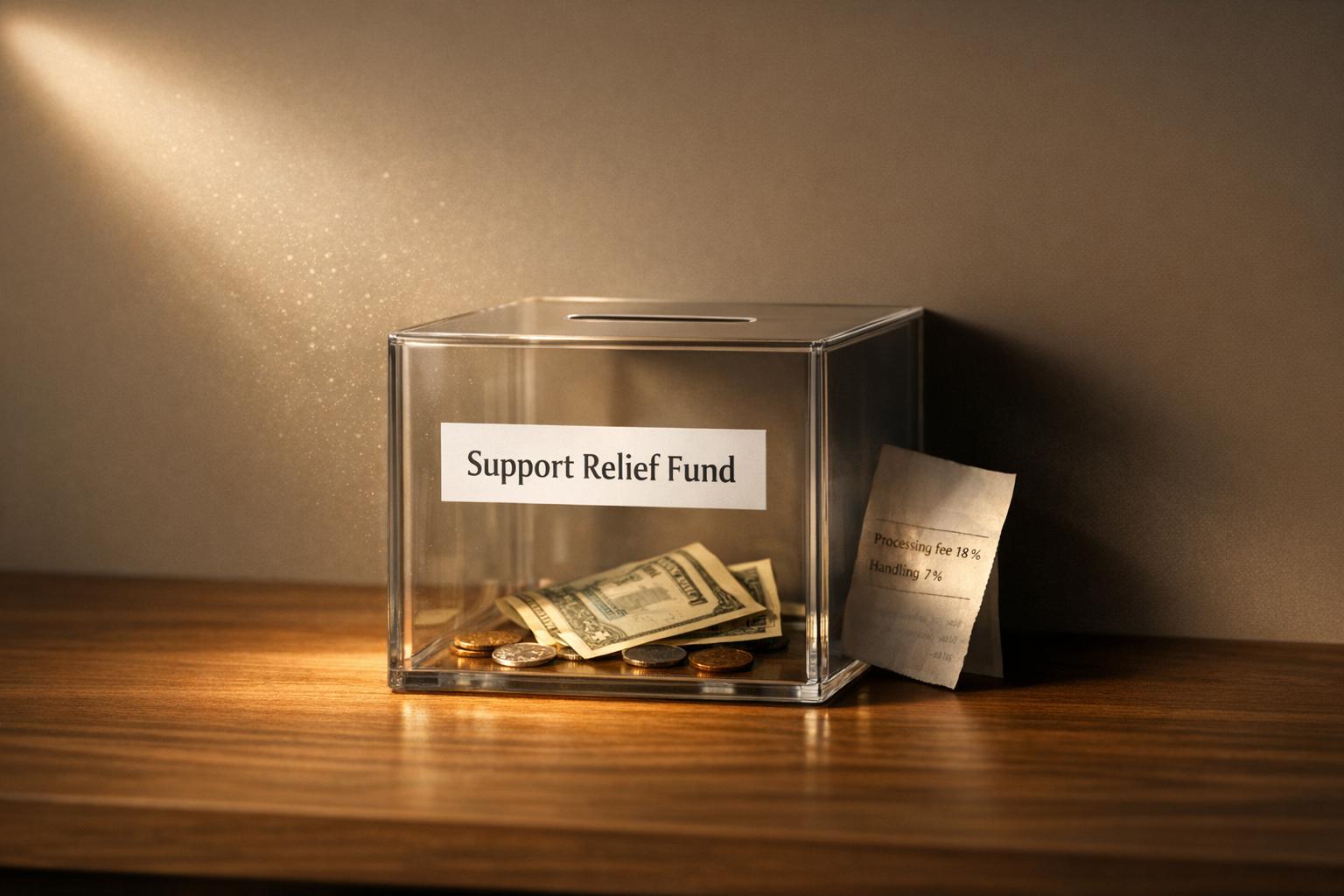
Misleading campaigns don’t always rely on outright falsehoods. Sometimes, the issue lies in what’s left unsaid. For example, failing to disclose that over 70% of a donation goes toward paying a third-party fundraiser can mislead donors. Similarly, claims like "100% of donations" can cause confusion when overhead costs are not properly explained.
Vagueness is another red flag. Whether it’s unclear descriptions of services or the use of outdated or staged images, these tactics leave donors guessing about the real impact of their contributions. And here’s a telling statistic: 54.5% of donors say they’d think twice about giving if they learned a charity used AI-generated images that weren’t verified by staff.
As the Give.org (BBB Wise Giving Alliance) explains:
"Accuracy generally refers to the facts and figures... Truthful refers to whether the charity says something that it knows not to be true... Misleading is a situation where every statement used in an appeal may be technically accurate, but together, they may provide the potential donor with a misleading impression."
– Give.org (BBB Wise Giving Alliance)
These practices don’t just mislead - they actively erode trust between donors and organizations.
Effects on Donor Relationships
When donors feel misled, the fallout can be severe. Broken trust often leads to feelings of betrayal, making donors less likely to give again. In fact, 73.4% of donors prioritize truthful, accurate, and clear appeals when deciding to contribute. Constantly asking for donations without showing results only deepens the divide, leaving donors feeling more like cash machines than valued supporters.
The ripple effects go far beyond individual donors. Misleading campaigns worsen what’s known as the "leaky bucket" problem - where less than 25% of first-time donors make a second gift. Younger generations, in particular, are less forgiving. Only 46% of Gen Z adults trust nonprofits, compared to 67% of baby boomers. This lack of trust spreads through negative word-of-mouth, making it even harder for organizations to attract and retain donors in the future.
sbb-itb-deea482
Deceptive Practices to Avoid
Hidden Fees and Tip Structures
Nonprofits often face processing fees ranging from 2.9% to 5%, plus $0.30–$0.50 per transaction. But how these fees are communicated to donors can significantly impact trust and giving behavior. A 2022 study by the American Cornerstone Institute revealed that nonprofits asking donors to cover transaction fees saw a 38.5% drop in conversion rates and a 20.5% decline in total revenue, even though those who completed their donations gave 3% more on average.
The way these fees are presented matters. For example, pre-selecting a "cover the fee" option can feel manipulative and undermine trust. Lindsey Hood from Givelify explains it this way:
"When donors encounter phrases like 'processing fees' or 'cover costs,' their perception shifts. What began as an emotional, mission-driven act of generosity suddenly feels like a financial transaction - like checking out at an online store."
– Lindsey Hood, Givelify
To maintain trust, nonprofits should offer fee coverage as an opt-in choice, with real-time calculations that show donors exactly how their contribution is allocated. Transparency here is key, and it’s equally important to avoid donation processes that feel unclear or overly complicated.
Unclear Donation Processes
A confusing or fragmented donation process can drive donors away. When nonprofits rely on disconnected tools, it often leads to data silos, disorganized records, and poor follow-up. Complex checkouts or unexpected fees can also increase donation abandonment.
Consider this: a nonprofit processing $1,000,000 in donations could lose anywhere between $37,200 and $91,200 annually in platform and transaction fees alone. On the other hand, organizations that prioritize a clear and straightforward donation experience can boost contributions by as much as 40%. Simplicity and transparency are essential, and misrepresenting tax-deductibility is another area where nonprofits must tread carefully.
Misrepresentation of Tax-Deductibility
Misleading donors about tax-deductibility can create confusion and even lead to regulatory penalties. According to the IRS, nonprofits must provide written acknowledgment for donations of $250 or more. For quid pro quo contributions over $75 - where donors receive goods or services in return - nonprofits are required to disclose the fair market value of those benefits.
As Ellis Carter, a nonprofit lawyer at Caritas Law Group, puts it:
"Donors deserve clear, honest disclosure."
– Ellis Carter, Caritas Law Group
Failing to disclose this information is considered "deception by omission" by the FTC. To avoid these pitfalls, nonprofits should promptly issue acknowledgment letters for donations exceeding $250, clearly outline the value of any goods or services provided, and carefully review all financial claims in their fundraising materials. Transparency not only builds trust but also ensures compliance with legal guidelines.
Consequences of Misleading Campaigns
Reputational and Financial Costs
Nonprofits lose an estimated 5% of their annual revenue to misleading campaigns, with a median financial loss of $100,000. Trust is at the heart of nonprofit success. Once trust is broken, the damage goes beyond immediate donations - it creates a ripple effect that undermines future funding. Donors who feel confident in a nonprofit tend to stick around longer, contributing to a much higher lifetime value. Implementing a donor welcome series can help solidify this connection from the start.
Transparency matters. Nonprofits that share audited reports and maintain clear practices see 53% more contributions, while those lacking transparency experience 47% fewer donations. Deceptive actions don’t just harm individual organizations - they tarnish the reputation of the entire nonprofit sector. Eric Bailey, Head of Endowments and Foundations at CAPTRUST, explains the broader impact:
"When an endowment or a foundation is less than forthright, it puts a blemish on the entire nonprofit community."
– Eric Bailey, CAPTRUST
The disconnect between donor expectations and reality is growing. While 73% of donors say trust is highly important, only 20% place high trust in charities. Additionally, 32% of Americans trust charities less now compared to five years ago.
The fallout doesn’t stop with financial loss and declining donor confidence. Misleading practices also invite increased scrutiny from regulators.
Regulatory Scrutiny
Deceptive campaigns often lead to legal consequences. The Federal Trade Commission (FTC) and state attorneys general actively pursue nonprofits engaged in misleading practices through initiatives like "Operation Phoney Philanthropy", which focuses on both law enforcement and public education. A common target is "deception by omission", where charities fail to disclose critical facts - such as most donations being spent on fundraising fees instead of programs.
State attorneys general wield significant power in these cases. They can issue subpoenas, file lawsuits for fraud, and even push for legislation that limits tax deductions to the portion of donations actually used for charitable purposes. A landmark case, Madigan v. Telemarketing Associates, decided by the U.S. Supreme Court in 2003, ruled that the First Amendment does not shield fundraisers from fraud liability if they deliberately mislead donors. In that case, a firm retained 85% of donations as fees, leaving just 3% for actual programs.
Recent enforcement actions highlight the risks. For example, a $75,000 settlement with the Cancer Society of America and legal action against the Saratoga County Deputy Sheriffs' Benevolent Association - where only 10% of revenues supported charitable activities - demonstrate the consequences of deceptive fundraising. These legal battles not only penalize specific organizations but also deepen the trust deficit across the nonprofit sector.
Misleading practices can also lead to audits, potentially resulting in the loss of tax-exempt status. Losing this status increases an organization’s tax burden and makes it less appealing to donors who can no longer claim deductions. Additionally, nonprofits may have to redirect resources from their mission to handle forensic accounting and legal challenges.
Rebuilding Donor Trust Through Transparency
Transparent Communication Practices
There's a significant gap between what donors expect and what they experience. While 67% of donors say trust is extremely important, only 22% feel they actually trust the organizations they support. Yet, nonprofits that prioritize transparency can see donations increase by as much as 40%.
The key lies in making clear, measurable commitments. Instead of broad statements like "helping children in need", nonprofits should outline specific goals, such as "providing weekend food backpacks to 150 students." Financial transparency is equally vital - sharing IRS Form 990s, audited financial statements, and detailed fund allocation reports on the organization's website shows responsible financial management.
Real-time tracking tools can also make a big difference. By using secure banking APIs, nonprofits can let donors follow their contributions from the moment they give to the impact it creates. For example, one animal shelter that implemented such a system in 2023 saw its online donations double in just six months. Donors who feel connected to the results of their giving are five times more likely to increase their contributions over time.
Being upfront about challenges, like budget shortfalls or project delays, also strengthens credibility. As Tina Nguyen from LinkedIn wisely points out:
"Trust isn't just important for new charities and community efforts - it's everything".
These steps lay the groundwork for adopting broader ethical practices in fundraising.
Adopting Ethical Fundraising Standards
Ethical fundraising provides a clear framework built on principles such as integrity, transparency, donor privacy, financial accountability, and avoiding conflicts of interest. When an organization consistently adheres to these principles, it earns the trust of its stakeholders.
Organizations that embrace transparency often see a threefold increase in donor retention and a 2.5× rise in average donation size. Additionally, 85% of donors are more likely to recommend nonprofits that demonstrate accountability. Focusing on measurable outcomes - like reducing food insecurity in a community - rather than just outputs can also attract larger grants and boost donor confidence.
Creating a centralized "Trust Center" on the nonprofit's website is another effective step. This could include governance documents, conflict of interest policies, whistleblower policies, and summaries of board meetings. Replacing dense annual reports with quarterly updates and simplified financial summaries - featuring charts of income sources and expense breakdowns - makes it easier for donors to understand where their money is going.
Strong ethical practices not only enhance transparency but also set the stage for innovative ways to engage donors.
Using Share Services for Better Donor Engagement
Building on ethical foundations, digital tools like Share Services can help nonprofits strengthen donor relationships. Share Services specializes in donor retention and digital fundraising for organizations with annual revenues between $1 million and $20 million. Their approach focuses on personalized messaging, moving beyond generic emails to show donors exactly how their contributions are making an impact.
Consistent messaging through Share Services can increase brand recognition by up to 80%, shaping donors' impressions from the start. They offer tailored packages to meet different needs, with digital marketing starting at $1,500 per month, strategic support at $3,500, and comprehensive project budgets at $3,000. These services ensure nonprofits can maintain consistent, personalized communication with their donors, leading to stronger engagement.
As Katie Bardine, Client Service Associate at Alford Group, explains:
"The ongoing practice of building trust among stakeholders goes far beyond dollars and tax documents. It's about activating your transparency from passive communication to action".
With the right tools and expertise, Share Services helps nonprofits turn transparency into meaningful donor connections.
How to Get Donors to Trust You with Their Money (So They Keep Giving)
Conclusion
A culture of transparency isn't just a nice-to-have for nonprofits - it's essential to counteract misleading campaigns and build trust with donors.
Trust forms the backbone of every dollar raised. Without it, even the most inspiring mission can struggle to gain traction. Consider this: while 67% of donors say trust is crucial, only 22% feel high trust in organizations they support. That gap represents a huge missed opportunity to grow your mission's impact.
By prioritizing honest communication, ethical fundraising, and consistent follow-through, nonprofits can thrive. Here's the proof: organizations that embrace transparency can see up to 40% more donations. Plus, donors who feel genuinely connected to an organization’s impact are five times more likely to increase their contributions over time. These outcomes directly translate into more resources for the communities you aim to serve.
For faith-based nonprofits, this is especially critical. With 29% of donors already viewing religious organizations as the most trustworthy, any deceptive campaign risks eroding that advantage. As Lynne Wester, Founder of Donor Relations Group, wisely puts it:
"Trust takes years to build, seconds to break, and forever to repair".
Transparency doesn’t just address past missteps - it secures your mission’s future. Start by making clear, verifiable commitments. Share financial data openly and report consistently on both wins and setbacks. These actions demonstrate integrity far more effectively than any marketing pitch ever could.
Donors are paying attention. Make sure your actions align with your promises. The time to act is now.
FAQs
How can I tell if a fundraising appeal is misleading?
To identify a misleading fundraising appeal, keep an eye out for exaggerated claims, missing critical details, or vague explanations about how funds will be used. Some common warning signs include:
- Overhyping the impact of their programs.
- Concealing high fundraising expenses.
- Failing to clearly outline how donations will support specific initiatives.
A trustworthy appeal should be upfront, honest, and offer a clear picture of the programs or causes it supports. Misleading ones, on the other hand, often manipulate by leaving out key information or crafting a narrative that misguides donors.
What disclosures should a nonprofit always show donors?
Nonprofits build trust and credibility by being open about their operations. This means sharing how donations are allocated - whether they go toward programs or cover administrative expenses. It's equally important to communicate the organization’s mission and the tangible results of contributions. Financial transparency is key, too. Providing details about budgets, revenue sources, and even fundraising practices (like third-party fees) helps donors understand where their money is going. When nonprofits prioritize clear and honest communication, they empower donors to make informed choices and strengthen long-term relationships.
How fast can donor trust be rebuilt after a mistake?
Rebuilding donor trust after a misstep depends largely on how serious the issue was and how the organization handles it. Trust can start to recover within a few months if the organization prioritizes transparency, accountability, and clear communication. However, fully restoring confidence often takes years. The key lies in consistent actions - acknowledging the mistake openly and keeping donors informed with regular updates. These steps are essential for regaining credibility and ensuring long-term donor confidence.
Related Blog Posts
Get helpful resources, straight to your inbox
We love sharing tools, ideas, and stories that make nonprofit work a little lighter and a lot more effective. Sign up below and we’ll send you practical tips, free resources, and a bit of encouragement—because the work you’re doing matters.
No spam. Just good stuff for good people.