
Feb 16, 2026
Push Notifications for Faith-Based Donors
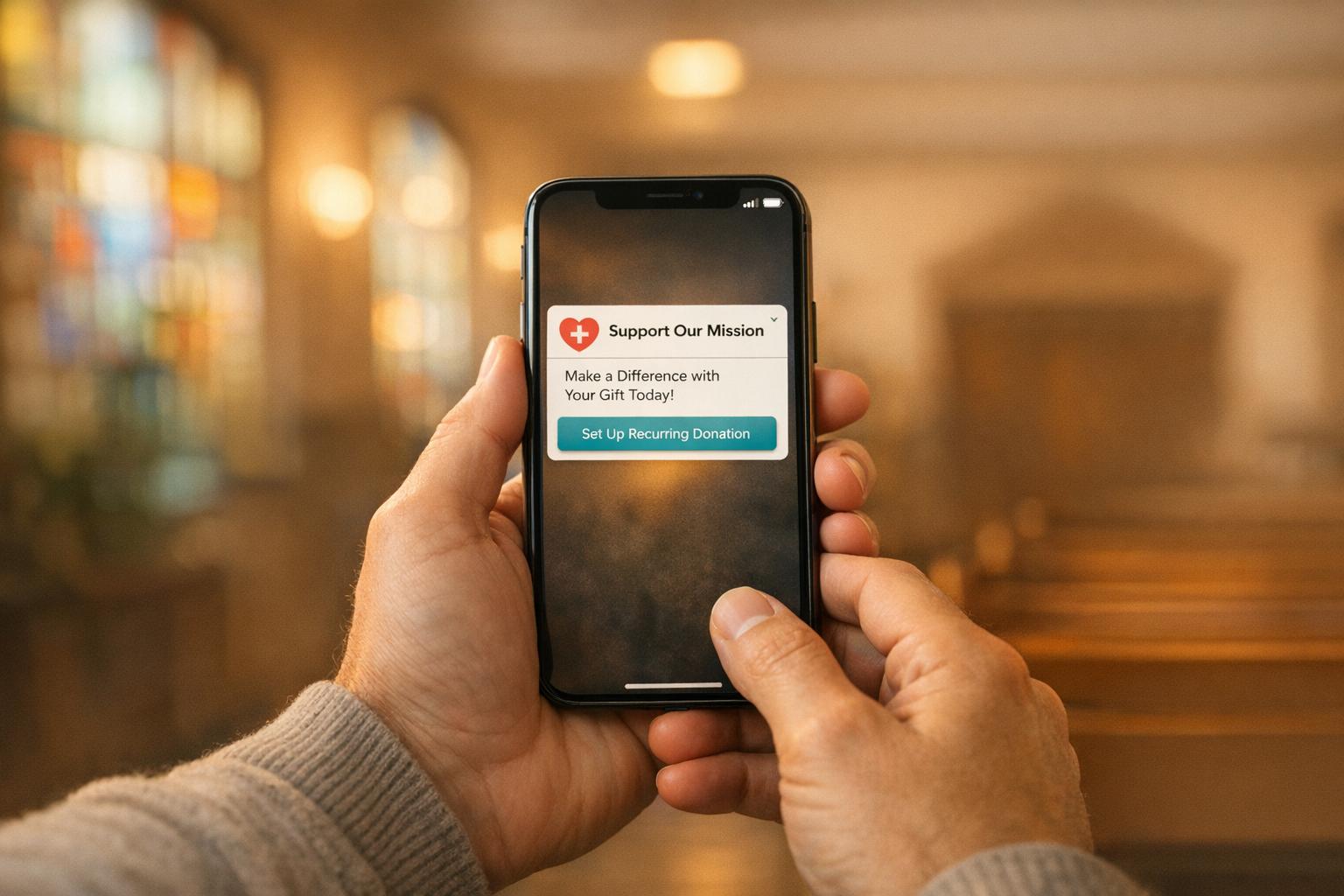
Push notifications are a direct, effective way for faith-based organizations to connect with supporters on their mobile devices. These short messages bypass crowded inboxes and social media algorithms, appearing instantly on users' screens. With open rates between 50% and 80% and response times as fast as 90 seconds, they are a powerful tool for driving engagement, increasing donations, and boosting event participation.
Key takeaways:
- Mobile-first giving: 53% of faith-based donors prefer donating via mobile devices.
- High engagement: 90% of push notifications are read within 3 minutes.
- Recurring donations: Timely alerts can convert one-time donors into recurring supporters.
- Event success: Notifications improve attendance with reminders and live updates.
- Personalization: Tailored messages, geotargeting, and donor segmentation enhance relevance.
Faith-based nonprofits can use push notifications to share prayer requests, fundraising updates, event invites, and spiritual content, keeping donors engaged and connected to their mission.
Push Notification Statistics for Faith-Based Organizations
Why Push Notifications Work for Faith-Based Fundraising
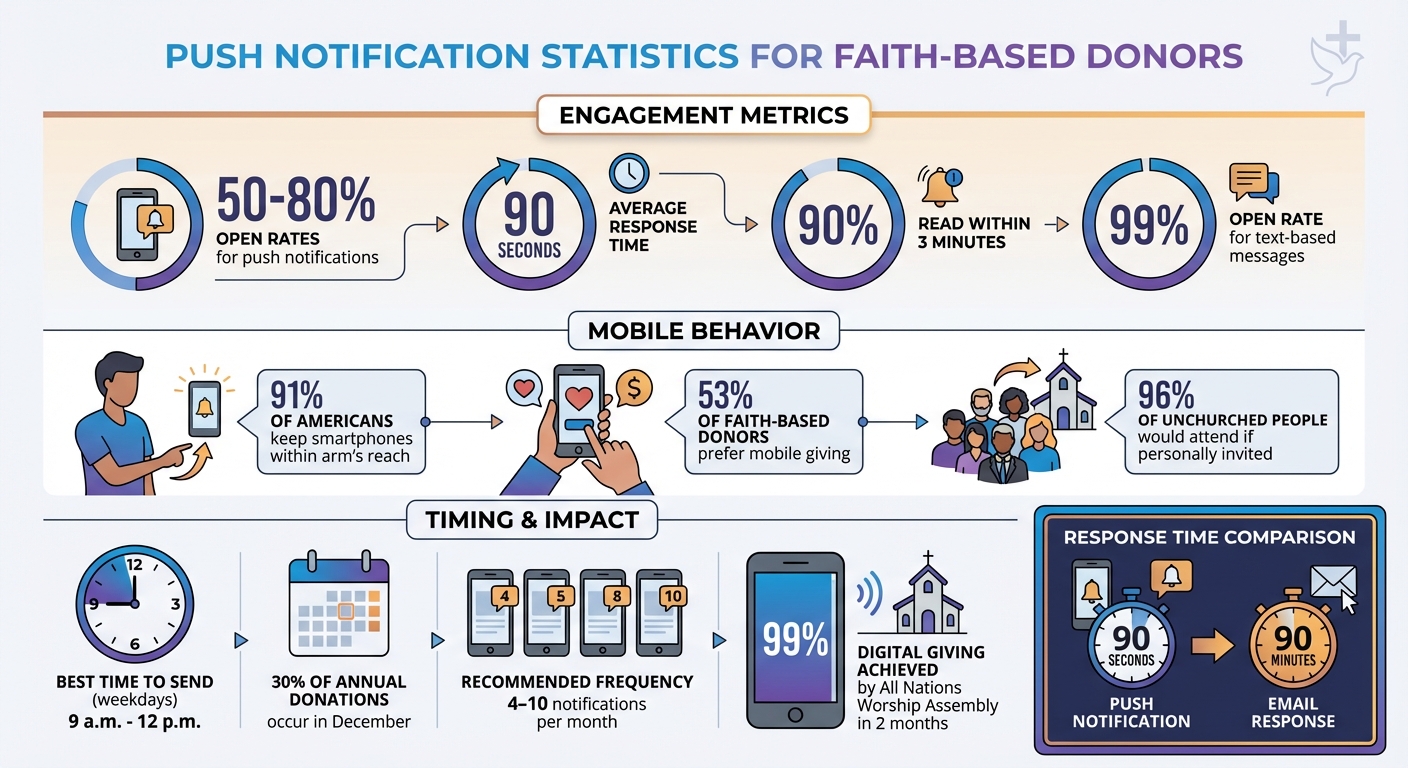
Push notifications cut through the noise of crowded inboxes and social media feeds. Unlike emails that often go unread or posts hidden by algorithms, push notifications appear directly on a donor's lock screen - even if your app isn’t open. This instant visibility leads to response times as fast as 90 seconds, compared to the 90 minutes it typically takes for an email to get a response.
The numbers speak for themselves: push notifications boast open rates between 50% and 80%, with some text-based messages reaching an incredible 99%. Since 91% of Americans keep their smartphones within arm’s reach at all times, your message can reach donors wherever they are - on their commute, in line at the store, or relaxing at home. Even better, 90% of these messages are read within 3 minutes of delivery. These stats highlight how push notifications’ immediacy and personalization can drive engagement like never before.
High Open Rates and Instant Delivery
For faith-based organizations, getting time-sensitive messages to supporters quickly is often critical. Whether it’s a prayer request for someone in the hospital, an urgent call for disaster relief, or a reminder about an upcoming live-stream, push notifications deliver the message instantly and effectively.
Using deep linking, you can make the process even easier by directing donors straight to a specific giving page or event registration form. This eliminates extra steps and encourages immediate action.
"When used effectively, push notifications can be the cornerstone of your church communication and engagement with your community, wherever they are." - Zach Boyd, Product Marketing, Pushpay
Timing also plays a role in success. Notifications sent between 9 a.m. and 12 p.m. on weekdays tend to perform best, aligning with donors’ morning routines and ensuring your message is seen at the right moment.
Personalized Messages That Build Donor Relationships
The combination of fast delivery and relevant content, such as a donor welcome series, helps foster trust with donors. Generic messages often fail to connect, but push notifications allow you to tailor your outreach. By segmenting your audience - whether by volunteer roles, giving history, or other criteria - you can craft messages that resonate with each group’s unique interests.
Geotargeting adds another layer of personalization. For example, you can send alerts to members near the church about local events, like spontaneous gatherings or service projects. This approach makes donors feel more connected and valued as part of the community.
Push notifications aren’t just for fundraising - they’re also a way to strengthen relationships through daily spiritual touchpoints. Sending Bible verses, devotionals, or prayer prompts keeps donors engaged and reminds them of your mission. Sharing real-time updates, like baptisms or missionary milestones, shows the impact of their contributions and deepens their sense of involvement.
Increasing Recurring Gifts and Event Attendance
Recurring donations are a lifeline for faith-based organizations, offering predictable income for long-term planning. Push notifications can help turn one-time donors into recurring supporters by sending timely nudges and linking directly to giving pages. They also help maintain recurring donations by alerting donors to issues like failed payments or expiring credit cards, ensuring their commitment stays on track.
When it comes to events, a well-timed sequence of notifications can boost attendance. Start with an announcement, follow up with a registration reminder, send a 24-hour alert, and finish with a "starting now" message. For example, in 2023, All Nations Worship Assembly in Chicago used Pushpay’s digital tools, including push notifications, to great success. Within two months, digital giving surged to 99% of their total contributions, thanks to features like text-to-give and mobile app integration.
"Pushpay has been the single greatest avenue of connection between the congregation and the church as a whole." - Sarah Jones, Worship Leader and Church Administrator, First Baptist Church in Reeltown
Interactive notifications can also boost engagement during services. Features like live polls or Q&A prompts encourage app use and provide real-time insights into attendance. For members unable to attend in person, push notifications can serve as invitations to join a livestream or watch a recorded sermon, ensuring they remain connected. Since 96% of unchurched people would attend a service if personally invited, these targeted messages can significantly improve participation rates.
sbb-itb-deea482
How to Set Up Push Notifications for Your Faith-Based Organization
To get started, focus on selecting the right tools, organizing your audience, and crafting meaningful messages. These steps can help you connect with donors and keep them engaged.
Selecting a Platform That Fits Your Needs
The platform you choose should work seamlessly with your church management system and offer features that make notifications engaging. Look for options that support rich notifications - these can include images, subtitles, and deep links to donation pages, event sign-ups, or videos. Scheduling tools are also essential so you can align your messages with key events on your church calendar. Another useful feature is an App Inbox, where users can catch up on missed notifications or read more detailed updates.
Once you've picked a platform, the next step is to organize your audience and ensure you're compliant with notification rules.
Segmenting Your Audience and Following Legal Requirements
Breaking your audience into smaller, focused groups ensures your messages feel relevant instead of overwhelming. For example, you might segment by ministry roles (like parents, volunteers, or small groups), by location for targeted alerts, or even by engagement level (such as in-person attendees versus livestream viewers). Tailoring your content to each group increases the likelihood that your messages will resonate.
It's also critical to follow legal guidelines. Users need to give explicit permission to receive notifications when they first download your app. Include settings within the app that allow them to join or leave specific notification groups as they choose. Avoid sending sensitive information via public push notifications, and be mindful of frequency - stick to 4–10 notifications per month to maintain trust and avoid opt-outs. As Zach Boyd from Pushpay explains:
"The biggest reason users opt-out of receiving push notifications is because they feel like they receive too many".
After setting up your platform and audience, the focus shifts to writing impactful messages.
Writing Clear and Effective Notification Messages
Your messages should be concise, engaging, and action-driven. Writing in the second person - using "you" and "your" - makes the tone more personal, like a direct invitation rather than a generic broadcast. Keep titles under 140 characters and include a clear call to action, such as a link to donate, register, or watch a sermon.
Create curiosity by sharing just enough to spark interest. For instance, instead of saying, "Our mission trip raised $10,000", try something like, "See how your generosity made a difference in Guatemala." Timing also matters - notifications sent between 9 a.m. and 12 p.m. on weekdays tend to perform best. Finally, make sure to proofread every message to maintain professionalism and build trust with your donors.
Proven Approaches for Faith-Based Push Notification Campaigns
Once your platform is ready, push notifications can become a powerful tool. By leveraging donor history, timing events strategically, and emphasizing urgency, you can not only secure donations but also strengthen the bond between your organization and its supporters. Let’s break down how personalized messages and timely alerts can amplify your fundraising efforts.
Targeted Giving Requests Based on Donor History
Your donor database is a goldmine for crafting personalized giving requests. Segment your audience into categories like new donors, regular contributors, and those who’ve stopped giving. This allows you to tailor messages to their specific journey of generosity. For instance, a message like, “Your $1,000 donation can provide five seats for our programming,” can resonate deeply. Deep linking can make this even more effective by directing users straight to donation pages or videos that showcase the impact of their contributions.
Matt Vuorela, CEO of the Steier Group, highlights the importance of this approach:
"When you tell your story well, clear, consistent and mission-driven messaging fosters trust, builds unity, and helps people visualize how their generosity connects directly to God's work".
Service and Event Reminders
Push notifications are ideal for keeping your community updated about worship services, outreach activities, or prayer gatherings. Whether it’s sending live stream links for those unable to attend in person or notifying parents about kids' check-in availability, these updates help foster engagement.
Timing matters for event reminders. Messages sent between 9 a.m. and 12 p.m. on weekdays often perform best. A simple notification like, “Tomorrow’s community dinner kicks off at 6 p.m. - tap here to RSVP,” provides clarity and encourages action.
While these reminders keep your community engaged, urgent notifications can rally support when time is of the essence.
Time-Sensitive Alerts for Critical Campaigns
Push notifications shine in moments of urgency, such as matching gift deadlines, disaster relief efforts, or year-end giving campaigns. December is a key month for many nonprofits and churches, with up to 30% of annual donations coming in during this time. A well-timed sequence - starting with an awareness alert in early December, followed by mid-month impact updates, and ending with a December 31st reminder - can maximize contributions.
For emergencies, such as supporting members in crisis, push notifications offer immediacy. A short, urgent message can mobilize your community to act quickly when it’s needed most.
Jonathan Louvis, SEO & AI Search Marketing Manager at Pushpay, underscores the effectiveness of this method:
"When technology works in harmony with your message, your church can reach more hearts - and fund more ministry - than ever before".
Using Push Notifications with Other Communication Channels
Pairing push notifications with email and SMS allows you to connect with donors through their preferred methods of communication. This combined approach leverages the immediacy of push notifications while extending engagement through thoughtfully timed emails and SMS messages.
Coordinating Push Notifications with SMS and Email
Each communication channel brings something unique to donor outreach. Push notifications are ideal for delivering instant alerts and engaging content like polls, images, or direct links to donation pages. Among app users, push notifications boast open rates ranging from 50% to 80%. SMS, on the other hand, is perfect for urgent, straightforward messages that don’t require an app - think volunteer reminders or last-minute updates. Email excels at sharing in-depth information, such as detailed updates or formal documents like year-end giving statements. Faith-based platforms often achieve email delivery rates as high as 99.9%.
Timing is everything when combining these channels. For example, you could send an email announcement first, follow it up with an SMS reminder a few days later, and then send a push notification 15 minutes before the event begins. This layered approach ensures you’re reaching donors at the right moments. Cristian Garcia of Christ Fellowship highlights the value of push notifications, noting:
"The push notifications allowed us to communicate with people even if they were not in the building".
In November 2018, Pushpay revealed that churches using their app experienced a 34% boost in engagement when they combined push notifications with email campaigns. This strategy not only increased event attendance but also drove higher donations by aligning targeted push notifications with email reminders, effectively reaching congregants across multiple touchpoints.
Maintaining Consistent Messaging Across All Platforms
When running multi-channel campaigns, consistency in messaging is essential. While the format may adapt to suit each platform, the core message should remain the same. Push notifications should be brief and action-oriented, whereas emails can include more detail and a conversational tone. Regardless of the channel, your tone should always reflect your organization’s identity - warm, mission-focused, and steady. Inconsistent messaging across platforms can confuse donors and undermine trust.
To avoid this, establish clear brand voice guidelines and create message templates that allow for platform-specific adjustments while staying true to your mission. Regularly review communications across all platforms to ensure alignment. Research shows that consistent brands are 3.5 times more likely to achieve strong visibility than those with inconsistent messaging. PushEngage explains:
"Real consistency is about maintaining your core brand personality while adapting to each channel's unique context and audience expectations".
Tracking Results and Improving Your Push Notification Campaigns
Once you've coordinated your multi-channel communications, the next step is to measure how well your push notification campaigns are performing and adjust them for better results. Start with the basics:
- Opt-in rate: This shows the percentage of visitors who agree to receive notifications. Aim for rates above 6% for web push and around 60% for mobile apps.
- View rate: This measures how many people actually see the notification on their screen, which typically ranges between 45% and 90%.
- Click-through rate (CTR): This reveals how many recipients clicked on the notification. A good average is 12%, with 5% as a baseline goal.
For faith-based organizations, conversion metrics are key. Keep an eye on total donations raised, the number of new recurring gifts, and how many people register for events.
Monitoring Important Performance Metrics
Beyond these basic engagement stats, dig deeper into metrics like direct versus influenced opens. A direct open happens when someone taps on the notification. An influenced open, on the other hand, occurs when a recipient interacts with your app shortly after receiving the notification. This second metric is particularly useful for understanding how your messages build awareness and drive action over time.
It’s also crucial to monitor your active subscriber list to ensure it stays healthy. Keep an eye on bounce rates - these are undelivered messages caused by issues like uninstalled apps or invalid tokens. High bounce rates can hurt the effectiveness of your campaigns.
To get more specific insights, segment your audience into groups - such as board members, volunteers, or small groups - and track how each group responds to different types of content. December is a critical month for many organizations, as it often accounts for up to 30% of annual donations. During this time, adjust your tracking to capture real-time performance data, helping you optimize those year-end campaigns.
Testing and Refining Your Messages
Once you’ve gathered enough data, it’s time to refine your approach with A/B testing. This method can help you understand what resonates most with your audience. Test one element at a time - like the call-to-action, wording, or imagery - so you can pinpoint what drives results. Start with a small portion of your audience, then send the most effective version to the rest.
Mike Snusz, Director of Nonprofit Customer Experience at Tatango, emphasizes the value of this approach:
"A/B testing is a great way to gather insight into your audience's motivations and interests, pointing you to ways you can more closely tailor your appeals to your different donors in the future".
Some high-impact variables to test include:
- Call-to-action language (e.g., "Donate Now" vs. "Support Our Mission")
- Message urgency and tone
- Personalization, such as including donor names
- Formats, like text-only versus notifications with images or GIFs
Even small tweaks can make a big difference. For instance, push notifications that include emojis can boost open rates by 85%, while adding rich media like images or GIFs can increase engagement by 25%. Start by experimenting with frequency - send 4–10 notifications per month, beginning on the lower end. Track opt-out rates to find the balance that works best for your audience. Use monthly engagement data to fine-tune your strategy further.
Getting Expert Help from Share Services
If you’re looking for professional support, Share Services offers tailored solutions for faith-based nonprofits. Their services include:
- Strategy Retainer: $3,500/month
- Monthly Project Budget: $3,000/month
- Paid Media Spend: $1,500/month
These packages are designed for nonprofits with revenues between $1M and $20M, providing data-driven strategies to connect with supporters more effectively. With expert guidance, you can ensure your push notifications continue to engage donors and drive meaningful results.
Conclusion
Push notifications offer faith-based nonprofits a direct and highly effective way to connect with donors on their mobile devices. With read rates hovering between 50% and 80%, these messages ensure that supporters receive updates right where they spend much of their time - on their smartphones. The secret to success lies in keeping notifications relevant through smart segmentation, finding the right balance in frequency, and ensuring each message inspires action - whether it’s donating to a campaign, signing up for an event, or watching a sermon video.
Take Springs Church, for example. During a "Connection Sunday" in September 2025, Pastor Michael used push notifications alongside a QR code for donations to an orphanage in Haiti. Within just 10 seconds, donations started flowing in through the church’s app. As Ashley Moore, Executive Administrative Assistant at Springs Church, explained:
"The app has just become the way that everybody finds the information that they need in the church".
To maximize impact, combine push notifications with email and SMS, use rich media to grab attention, and schedule your messages during peak engagement hours (9 a.m.–12 p.m.). Additionally, consider this: roughly 96% of unchurched individuals are somewhat likely to attend a service if personally invited. This makes push notifications a powerful tool not just for donor retention but also for outreach.
For nonprofits ready to embrace a data-driven strategy, Share Services offers tailored solutions for organizations with annual revenues between $1M and $20M. Their services include a Strategy Retainer at $3,500 per month, a Monthly Project Budget at $3,000 per month, and a Paid Media Spend plan starting at $1,500 per month. With the right tools and expert support, push notifications can become a game-changer for daily donor engagement.
FAQs
Do we need a church app to send push notifications?
No, you don’t need a dedicated church app to send push notifications. Many church communication platforms already include features like messaging, alerts, and notifications. These tools allow you to stay connected with your congregation without the need for a separate app.
How do we ask for donations without overwhelming supporters?
To keep your supporters engaged without overwhelming them, prioritize quality over quantity in your outreach. Reduce how often you send donation requests, and make sure every message you send offers something meaningful. Show donors the real impact of their contributions by connecting their giving to a broader mission or tangible results.
When using push notifications, keep them brief, focused, and purposeful. These updates should encourage involvement without feeling intrusive. Striking the right balance in your communication plan not only helps prevent donor fatigue but also lays the foundation for stronger, long-term relationships.
Which push notification metrics matter most for fundraising?
Key metrics for push notifications in fundraising start with the opt-in rate, which tells you how many people allow notifications - essential for knowing your potential audience. Then there’s the click-through rate (CTR) or direct open rate, both of which reveal how engaging your messages are.
Another critical number? Conversion rates - like how many donations come directly from your notifications - because they show the return on your efforts. On the flip side, monitoring opt-out rates and uninstall rates can help you understand if your messages are missing the mark or causing frustration.
Finally, using personalized, segment-based targeting can make a big difference. Tailored messages not only grab attention but also boost the chances of turning engagement into donations.
Related Blog Posts
Get helpful resources, straight to your inbox
We love sharing tools, ideas, and stories that make nonprofit work a little lighter and a lot more effective. Sign up below and we’ll send you practical tips, free resources, and a bit of encouragement—because the work you’re doing matters.
No spam. Just good stuff for good people.