
Feb 16, 2026
Social Media Strategies for Church Fundraising
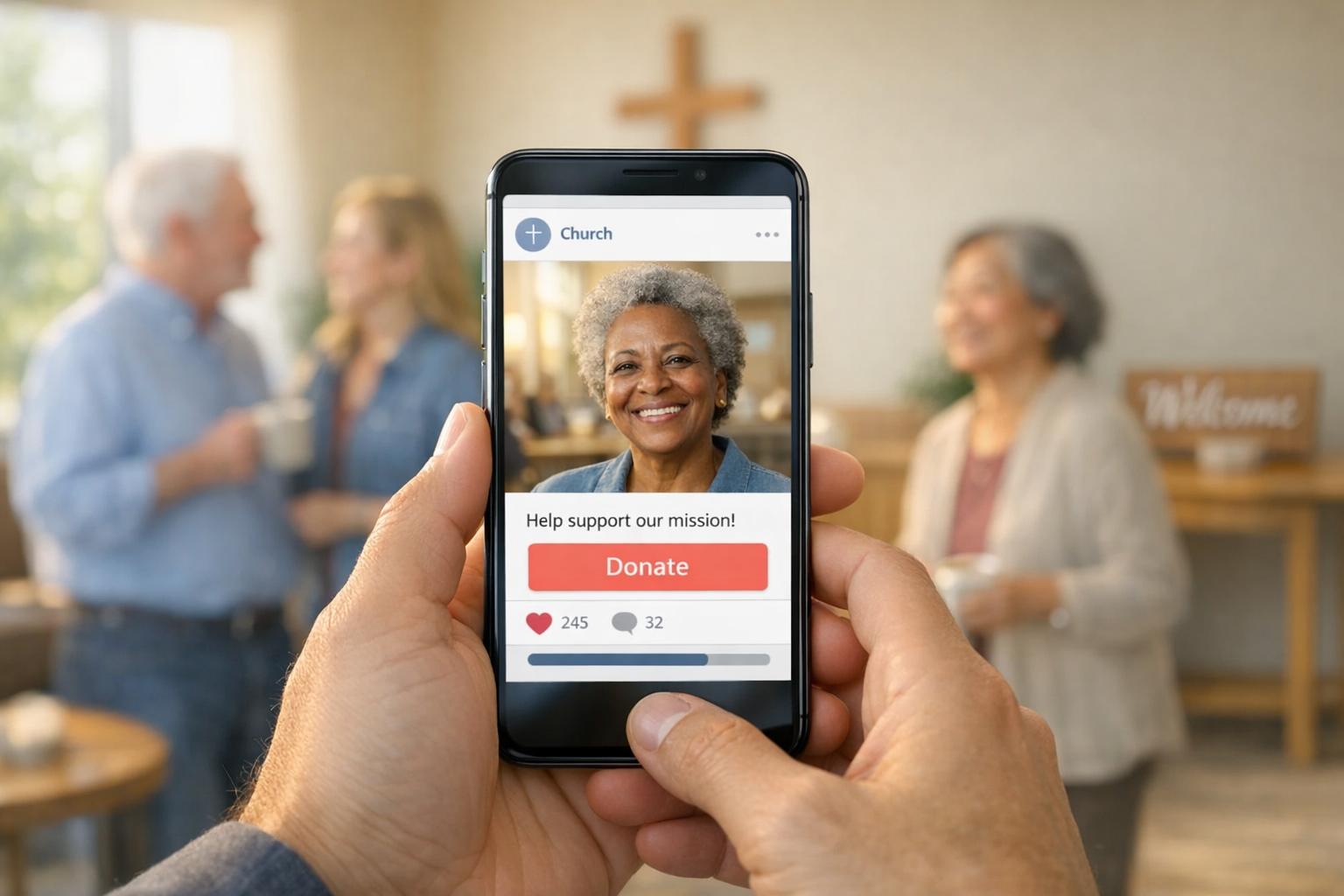
Churches can use social media to connect with their communities, engage donors, and boost fundraising efforts. With most Americans spending hours daily on platforms like Facebook, Instagram, and TikTok, these tools offer affordable ways to share your mission, interact with followers, and inspire giving. Here’s how to make it work:
- Set SMART Goals: Define clear objectives like gaining 50 new monthly donors or increasing donation sizes by 15%.
- Optimize Profiles: Use nonprofit accounts, include donation links, and ensure your bio and visuals reflect your church’s mission.
- Create Engaging Content: Share real stories, photos, and videos that highlight the impact of donations. Keep videos short and add captions for silent viewing.
- Use Donation Tools: Add “Donate” buttons on Facebook, Instagram, and YouTube to streamline giving.
- Leverage Paid Ads: Target specific audiences to reach new donors and maximize visibility.
- Encourage Interaction: Use live videos, polls, and hashtags to involve your community and make them feel part of your mission.
- Track Results: Monitor metrics like engagement rate, conversion rate, and donor retention to refine your strategy over time.
Social media isn’t just about posts - it’s about building deeper connections with your congregation and showcasing how their support makes a difference.

7-Step Social Media Fundraising Strategy for Churches
Setting Up Social Media Profiles for Fundraising
Building Professional Profiles
When setting up social media profiles for your church, always opt for nonprofit or business accounts instead of personal profiles. Why? These account types unlock powerful tools like "Donate" buttons and "Link Anywhere" cards, which aren't available on personal accounts. Make your church's logo the profile picture, ensuring it’s optimized for circular displays. For the cover photo, pick an image that highlights your congregation - perhaps during a service, community event, or volunteer activity.
Fill out every detail in your profile. Include a short bio (150–160 characters), your church’s location, and a direct link to your website or donation page. To keep things running smoothly, assign 2–3 administrators to each account. This ensures access remains intact if someone steps down from their role. Take inspiration from Potomac Valley Church, which grew its Instagram following from under 1,500 to more than 45,700 engaged followers between May 2020 and August 2024. Their posts now reach over one million people monthly. As Lead Pastor Will Archer shared, "Our social media presence has proven to be invaluable to our testifying to the Gospel". Once your profiles are polished, add donation tools to turn engagement into meaningful contributions.
Adding Donation Tools and Links
After verifying your nonprofit status, adding donation buttons is a simple process. On Facebook, enable the "Donate" button through your settings (you’ll need to enroll in Facebook Payments). For Instagram, go to profile settings, choose Business, then Donations, and toggle on the "Add Donate Button to Profile" option. On YouTube, add donation links in video descriptions and pin a comment during livestreams to draw attention to your fundraising efforts.
Strategic link placement is key. Since Instagram posts don’t allow clickable links, place your donation link in your bio. On Facebook, pin a post with your donation appeal so it’s always visible. For X (formerly Twitter), include the donation link in your profile bio and weave it naturally into your tweets. Consider creating a dedicated landing page (e.g., church.org/give-now) to streamline the donation process. This page could feature a compelling video or donor story to connect with visitors emotionally and encourage giving.
Working with Share Services for Account Management
Once your profiles and donation links are set up, maintaining a consistent social media presence can be a challenge - especially for church leaders juggling multiple responsibilities. This is where services like Share Services can help. Their Strategy Retainer ($3,500/month) provides a nonprofit strategist to handle account setup, campaign management, and performance tracking. This includes weekly strategy sessions, project management, and detailed KPI reporting. Additionally, their Monthly Project Budget ($3,000/month) covers essentials like branding, graphic design, web design, copywriting, donation pages, and optimizing conversions. These services can turn your weekly sermons into ongoing digital engagement.
The #1 Church Giving Trend That’s Transforming Generosity ⬆️
Creating Content That Encourages Donations
Every piece of content should reflect the mission of engaging your faith community and inspiring generosity.
Sharing Stories That Connect
Personal stories are a powerful way to build trust. When members of your congregation share experiences of faith, challenges, or answered prayers, it creates a sense of authenticity that resonates deeply with your online audience. Highlighting the impact of donations - whether it’s a family receiving help, a completed project, or a transformed life - can make potential donors feel more connected to your mission. One idea is to feature "Why I Give" segments, where past donors explain their motivations. Framing donors as heroes in these narratives - like asking, "Will you be someone's hero this winter?" - can be especially effective.
For videos, keep them under two minutes to maintain attention and include behind-the-scenes glimpses, such as staff preparing sermons or volunteers in action, to foster transparency and community engagement. End each story with a clear call to action, whether it’s donating, sharing, or attending an event. Pair these stories with visuals that complement the message.
Using Photos and Videos Effectively
Choose real images of your congregation and volunteers over generic stock photos to make your content feel more personal. Visual elements can significantly boost engagement - retweets on Twitter can increase by 150%, and Facebook engagement can be 2.3 times higher when visuals are used. Short videos between 30 and 60 seconds are ideal for explaining complex ideas quickly and memorably. Highlight your mission with photos that showcase your efforts, like delivering books or sharing before-and-after impact stories.
For videos, design them for silent viewing by adding captions or text overlays, as many users browse without sound. Visual tools like progress trackers - such as thermometers or milestone graphics - can create urgency and keep donors updated on campaign progress. Always obtain written consent before sharing images or videos of children, and maintain brand consistency by using your church’s logo, colors, and fonts throughout your graphics.
Keeping Donors Updated Regularly
Once you’ve created engaging stories and visuals, it’s crucial to keep the momentum going by staying in touch with donors. Focus on posting high-quality content 3–5 times a week, rather than daily updates that add little value. Mix up your content with testimonies, scripture, team highlights, and campaign updates to keep things fresh without making every post a direct donation request. Use Instagram and Facebook Stories for real-time updates, which can reach a large audience without cluttering your main feed.
Donors want to see the results of their contributions. Share final campaign outcomes to provide closure and celebrate the community’s collective achievement. Acknowledge donors publicly (with permission) or spotlight peer-to-peer fundraisers to inspire even more generosity. Experiment with posting at different times - like Sunday afternoons for recaps, midweek mornings for encouragement, and Friday lunchtimes for final campaign pushes - to see what works best for your audience.
"Through transparent and frequent communication, you will have more engaged donors who are more likely to give again because you have shown them how you put their generous gift to work".
Increasing Engagement with Interactive Features
Once you've set up a strong profile and created engaging content, the next step is to make your audience feel involved. Interactive features can transform passive followers into active participants who feel personally connected to your church’s mission.
Running Live Videos and Q&A Sessions
Live videos create a sense of immediacy and authenticity that pre-recorded content often lacks. With over 500 million people watching videos on Facebook daily and 45% of people spending more than an hour a week on platforms like Facebook or YouTube, live video is a powerful way to connect with your audience. The 25–34 age group, in particular, is highly engaged with online videos. While Facebook allows streams up to four hours, research suggests keeping them around 20 minutes for better engagement.
"Live video will inform people about the character of your church and help them understand and appreciate its culture."
- Jayson D. Bradley, Writer and Pastor
To maximize impact, announce your live stream at least 24 hours in advance. Start with a countdown timer to give viewers time to join, and assign a moderator to manage comments so the speaker can stay focused. A personal touch, like mentioning viewers by name, can make them feel more connected. Also, using an Ethernet cable instead of Wi-Fi can reduce buffering issues.
Live sessions are an excellent opportunity to explore topics beyond Sunday services, such as practical prayer guides or discussions on challenging questions like why suffering exists. These sessions also make it easier for people hesitant about attending physical services to engage with your church. Additionally, encouraging members to share their personal faith stories during these sessions can deepen the sense of community.
Getting Followers to Share Their Own Content
Encouraging your congregation to share their stories can significantly expand your reach. A dedicated hashtag (e.g., #ChurchNameGives) can make it easy for others to find and engage with these posts.
Interactive challenges are another way to inspire participation. For example, the Movember Foundation’s mustache-growing challenge has involved 6.8 million participants since 2003, raising funds for men’s health projects. Similarly, the #BettyWhiteChallenge in January 2022 raised $12.7 million for animal shelters by encouraging people to donate $5 and share tribute posts.
You can also provide Instagram Story templates with prompts like “I donated because…” to encourage your audience to share their involvement. Highlighting specific volunteers is another effective strategy - friends and family often share these posts out of pride, creating a ripple effect. For those unable to donate, a simple call to action like “Can’t give right now? Share this post to spread the word!” can still make a meaningful impact.
Interactive visuals and personalized responses, like publicly thanking supporters, can further strengthen connections and inspire even more engagement.
Using Polls and Surveys
Polls and surveys are a great way to turn one-sided communication into meaningful conversations. They allow you to gather insights directly from your audience, helping you move from guesswork to strategies based on real feedback.
Ask followers about their preferred social media platforms to focus your efforts where they’re most active. Use polls to determine interest in specific events or decide which community project should receive funding. When people feel their opinions matter, they’re more likely to feel invested in your mission.
For example, one house of worship saw a 25% increase in volunteer sign-ups after using automated post-event surveys. Storing these responses in your donor database lets you tailor future campaigns to align with your audience’s preferences. Twitter (X) polls also offer a quick way to gauge community sentiment on various topics.
"By harnessing actionable insights from analytics, ministries can move beyond guesswork to implement evidence-based strategies that deepen engagement and amplify outreach impact."
Include short polls in social media posts, newsletters, and follow-up emails to gather feedback wherever your audience is active. Questions about favorite worship songs, Bible verses, or impactful faith moments can also generate content that resonates with your community.
sbb-itb-deea482
Expanding Reach with Paid Ads and Partnerships
Organic posts are great for engaging your current followers, but if you want to connect with a broader audience, paid ads and partnerships are the way to go. With nonprofit organic reach dwindling to just 2–6% and acquisition costs increasing by 192% over the last three years, it's clear that a more strategic approach is necessary to expand your visibility. Let’s dive into how partnerships and targeted ads can help you reach new potential donors.
Partnering with Influencers and Community Leaders
Teaming up with local influencers who share your church’s values can amplify your message far beyond your congregation. The sweet spot? Micro-influencers - those with smaller but highly engaged audiences. For example, St. Jude PLAY LIVE collaborated with influencers and gamers to raise over $45 million, while the #TeamSeas campaign enlisted YouTubers to bring in more than $34 million with the help of 400,000 creators. Churches like St. Mark’s in Portland have also successfully worked with local ambassadors to share their mission in a genuine way.
Think about identifying ambassadors within your own congregation. These could be members willing to share personal "Why I Give" stories or create heartfelt, selfie-style video invites. St. Mark’s Church in Portland, Oregon, used YouTube ads featuring emotional storytelling from community leaders to rally support for their infrastructure campaign, ultimately exceeding their goal. To make it easy for your partners, provide them with pre-made social media templates they can use to spread the word.
"Engagement isn't a vanity metric - it's a survival metric."
- Matthew Schaller, Co-Founder and CEO, GoodUnited
Once you’ve built strong partnerships, you can use targeted paid ads to further connect with local donors.
Running Targeted Paid Ads
Facebook and Google ads offer a level of precision that organic posts simply can’t match. With 72% of American adults active on social media, paid ads ensure your fundraising message gets in front of the right people, even with organic reach limitations.
Take Share Services’ Paid Media Spend as an example. With a $1,500 monthly budget, they run targeted ad campaigns on Facebook and Google to maximize donation potential. Even if your budget is smaller - starting at just $5 per day ($150 per month) - you can still reach thousands of local community members daily.
"Using Facebook ads without precise targeting wastes potential - tap into hyper-local and custom audiences for real impact."
- Blake Adams, Editor, Pushpay
Effective campaigns focus on hyper-local targeting (reaching users within five to ten miles of your church), custom audiences (like website visitors), and lookalike audiences based on your current members. Align these ads with specific fundraising goals to get the best results.
Choose your campaign objectives wisely. Engagement campaigns can increase post interactions, traffic campaigns drive visitors to your donation page, lead generation campaigns collect contact information, and messaging campaigns open direct conversations through Facebook Messenger. For year-end giving, you can even upload email lists of past donors to send targeted reminders.
To build trust, feature real church members or leaders in your ads instead of stock photos. Include captions in video ads since many users scroll through social media without sound. And don’t forget to clearly show why someone should connect with your church - highlight the sense of community and the practical support you offer.
Setting Up Facebook Fundraisers
If you haven’t already, register your church as a nonprofit on Facebook to access its fee-free fundraising tools. Once approved, set a clear fundraising goal and use compelling photos or videos to tell your story. Explain how donations will be used, and promote your fundraiser through regular posts, live videos, and paid ads. You can also encourage congregation members to create personal fundraisers to support your campaign. Keep momentum going by sharing updates on milestones throughout the effort.
Measuring Results and Improving Campaigns
Tracking your campaign's performance is essential when using social media to boost engagement and donations. Without monitoring results, you're essentially guessing what works. By understanding the impact of your efforts, you can fine-tune your strategy and make the most of your fundraising budget.
Tracking Key Metrics
Start by keeping an eye on reach and impressions. Reach measures how many unique people see your content, while impressions count the total number of times your posts appear on screens - whether they’re viewed by the same or different users.
Next, calculate your engagement rate using this formula:
(Total interactions ÷ Total impressions) × 100
An engagement rate of 1% to 2% is typical, while hitting 4% to 5% signals strong performance.
Another critical metric is the conversion rate, which tracks the percentage of users who take meaningful actions, like donating or signing up for events. For fundraising, also focus on metrics like the average donation amount, donor acquisition (first-time donors), and donor retention (repeat donors). To understand the bigger picture, calculate your donor lifetime value (LTV) - this shows the long-term financial impact of your donor relationships.
To simplify tracking, use tools like Meta Business Suite for Facebook and Instagram or Twitter Analytics to measure post performance. You can also set up UTM tracking codes to follow the journey from a social post to a completed donation. These tools provide the data you need to refine your campaigns and improve results over time.
Adjusting Strategies Based on Data
Once you've tracked your metrics for a few weeks and established a baseline, use this data to adjust your strategy. For example, if your stats show that video posts consistently outperform other formats, lean into creating more video content. Similarly, tweak your posting schedule to align with the times your audience is most active.
Demographic insights - like age, gender, and location - can also guide your content strategy. For instance, if younger moms engage more on Instagram while families prefer Facebook, tailor your content to each platform. Experiment with different formats and posting times to see what resonates best. Focus on encouraging shares and comments over simple likes, as these deeper interactions can increase your content’s visibility.
Using Share Services for Campaign Improvement
If you're looking for professional help to turn these insights into action, Share Services offers a Monthly Project Budget of $3,000. This service supports churches by providing expert solutions in content creation, branding, and conversion optimization to enhance online giving. With their guidance, you can focus on proven strategies like short video devotionals or storytelling posts. They also analyze donor demographics and giving patterns to design campaigns that reach the right audience at the right time.
Conclusion
A social media strategy isn’t just about sharing updates - it’s about forging meaningful connections with your congregation and donors. By blending genuine storytelling, consistent interaction, and smart, data-informed adjustments, you can establish a long-term plan that aligns with your church's mission and strengthens its impact.
Action Steps to Start Now
To put these strategies into motion, start with a few practical steps. First, review your social media profiles to ensure they look professional and are optimized for donations. Next, define 5–7 content categories - like Team Spotlights, Scripture Reflections, or Youth Ministry Updates - to keep your content engaging and varied. This approach prevents burnout while ensuring your feed stays fresh.
Assemble a small team of 4–5 volunteers, assigning specific roles such as design, copywriting, and video editing. This not only reduces the workload on any single individual but also brings diverse perspectives to your content. To maintain consistency, use scheduling tools to plan and batch your posts ahead of time.
If you’re looking for expert support, services like Share Services offer tailored solutions for content creation, branding, and donor engagement. They can help you analyze donor behavior and connect with the right audience at the right time.
Long-Term Benefits of Social Media Fundraising
Beyond immediate results, a strong social media strategy creates lasting benefits for your ministry. It’s not just about raising funds - it’s about extending your pastoral care and staying connected with your community throughout the week. As Danielle Davis from Churchfluence wisely notes:
"Social media isn't about chasing trends. It's about stewarding your message".
Focusing on community-building instead of simply growing your audience fosters deeper relationships, which often lead to sustained support. For instance, adding an online giving option can boost church donations by 32%. Combining social media with other channels like email and your website ensures you meet the preferences of a broader audience, offering financial stability.
FAQs
Which social platform should our church focus on first?
By 2026, Facebook remains a top choice for building an online presence. With a staggering 3 billion monthly users, it connects people across a wide range of age groups, making it one of the most inclusive platforms out there.
What makes Facebook so effective? It offers a variety of tools to help you engage with your audience. You can create pages for sharing updates, use live streams to connect in real-time, and build groups to foster deeper community interaction. Plus, its event promotion features - like RSVP tracking - are perfect for organizing fundraisers, services, or any gathering that requires a personal touch.
While platforms like Instagram and YouTube also have their strengths, Facebook’s combination of versatility and massive reach gives it a distinct edge when you're just starting out.
What’s the fastest way to increase online donations from social media?
To increase online donations through social media, focus on creating campaigns that grab attention and encourage action. Share inspiring stories that connect emotionally with your audience, and always include clear calls-to-action alongside easy-to-use donation links. Platforms like Facebook Fundraisers can be a great tool, or you can motivate your supporters to launch their own fundraising campaigns.
Make sure your church’s website features a prominent, mobile-friendly “Give Now” button so people can donate easily. Regularly post impactful visuals and heartfelt stories to spark a sense of urgency and inspire your community to get involved.
How can we tell if our social media fundraising is effective?
To gauge how well your social media fundraising efforts are performing, focus on a few important metrics. These include engagement rate (likes, shares, comments, and clicks), conversion rate (how many interactions result in donations), and your overall reach. By regularly reviewing these data points, you can figure out what’s effective, fine-tune your approach, and strengthen connections with donors. Keeping an eye on your social media ROI also ensures your work stays aligned with your goals and delivers impactful outcomes.
Related Blog Posts
Get helpful resources, straight to your inbox
We love sharing tools, ideas, and stories that make nonprofit work a little lighter and a lot more effective. Sign up below and we’ll send you practical tips, free resources, and a bit of encouragement—because the work you’re doing matters.
No spam. Just good stuff for good people.