

Dec 15, 2025
Storytelling for Major Donor Retention
Donor retention is critical for nonprofits, especially with major donors who provide $1,000 or more. Yet, many organizations lose these key supporters due to a lack of personal connection and meaningful engagement. The solution? Storytelling. By sharing real, impactful stories, nonprofits can transform one-time gifts into lasting partnerships.
Key Takeaways:
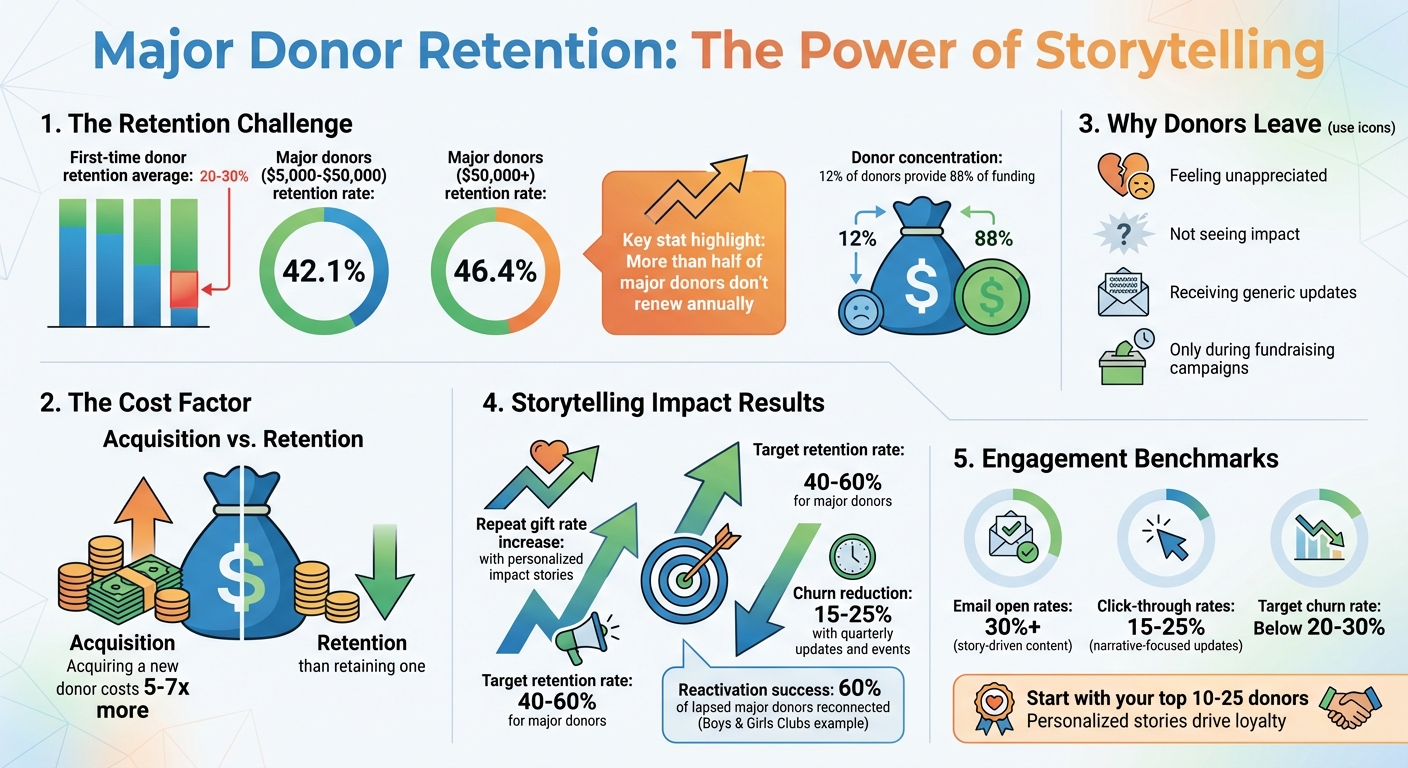
- Retention Challenges: First-time donor retention averages 20–30%. For major donors, over half don’t renew annually.
- Why Donors Leave: Feeling unappreciated, not seeing impact, or receiving generic updates.
- Storytelling Benefits: Builds emotional connections, highlights donor impact, and positions them as heroes in the mission.
- Actionable Strategies:
- Send thank-you messages that show specific results.
- Share personalized quarterly updates with stories and data.
- Use reports structured around Need → Response → Results → What’s Next.
- Host virtual events featuring real stories and beneficiary interactions.
- Use multi-channel communication (email, print, video) to keep donors engaged year-round.
Why It Matters:
Acquiring a new donor costs 5–7 times more than retaining one. Effective storytelling not only boosts retention rates but also fosters deeper donor relationships and long-term support. Start small: focus on your top donors, share personalized impact stories, and maintain consistent communication.
Major Donor Retention Statistics and Storytelling Impact
Episode 213: How to Write Donor Stories That Move People to Give (Using Show, Tell, Ask)
How Storytelling Keeps Donors Engaged
Major donors aren’t just looking to write a check - they want to feel like they’re part of something meaningful. Storytelling transforms giving into more than a transaction; it builds a genuine relationship. Instead of simply stating a donation amount, say something like, "Because of you, 32 families found stable housing this year, including Maria’s children, who are now thriving in school." This approach makes donors feel directly connected to the impact of their contributions, which increases the likelihood they’ll continue supporting your cause. This emotional connection lays the foundation for stronger, lasting donor commitment.
Here’s the reality: Between 2023 and Q2 2024, major donors contributing $5,000–$50,000 had a retention rate of 42.1%, while those giving $50,000 or more retained at 46.4%. That means more than half of major donors don’t renew their support each year. Why? Often, it’s because they never feel the emotional connection that deepens their commitment. Storytelling helps bridge this gap by clearly defining the problem, showing the path to a solution, and emphasizing the donor’s personal role in creating change.
Creating Emotional Connections with Personal Stories
The most effective stories focus on a relatable character facing a clear challenge. Instead of saying, "Your support helped our housing program," try sharing a vivid narrative: "When winter temperatures dropped below 20°F in January, your gift kept our shelves stocked so families like the Rodriguezes didn’t have to choose between heating their home and buying groceries. Over three months, you helped provide 8,300 meals across three neighborhoods".
Stories like these work because they cast donors as the heroes of an unfolding story of change, rather than just sources of funding. For instance, an animal shelter might say, "Stray intake is up 40% in our city, but thanks to your support, we built a foster network that placed 210 animals in homes this year." This kind of storytelling positions donors as key players in solving real-world challenges, transforming them from passive contributors into active mission partners.
Why Standard Updates Don’t Work
Generic updates and newsletters often fail to engage major donors. Why? They treat all donors the same, even though just 12% of donors provide 88% of funding. These updates tend to focus on organizational activities rather than highlighting the specific outcomes made possible by donor contributions. Without a clear connection to the impact of their gifts, donors are left wondering if their support truly matters. And when updates only arrive during fundraising campaigns or at the end of the fiscal year, it becomes obvious they’re being contacted solely to meet financial goals - not to build a meaningful relationship.
Another issue with standard updates is their reliance on impersonal, institutional language. Phrases like "strategic initiatives" or "leveraging synergies" feel cold and distant. Donor-centered storytelling, on the other hand, uses language like, "Because of you, three new classrooms opened this fall," and connects with donors throughout the year - not just when asking for money. Without this personalized, story-driven approach, even the most generous donors can feel overlooked or undervalued, making it easier for them to redirect their support elsewhere.
5 Storytelling Strategies to Keep Major Donors
Personalized storytelling is a powerful way to strengthen connections with major donors. To maintain their support, it’s essential to engage them consistently throughout the year with a structured approach: Ask → Thank → Report → Engage → Repeat. Here are five actionable strategies to turn one-time contributions into long-term partnerships.
Write Thank-You Messages That Highlight Impact
A prompt and heartfelt thank-you can make all the difference. Send a quick acknowledgment within 24–48 hours, followed by a more detailed message - via letter or video - within a week. The secret? Tie the donation to a specific, tangible result. Avoid generic phrases like "thank you for your support." Instead, show exactly how their gift made a difference.
For instance, a nonprofit focused on homelessness might say:
"Thanks to your $15,000 gift, 30 families (at $500 per family) moved from shelters into safe housing in 2025. Maria, a mom in Phoenix, shared, 'My kids finally have a bedroom of their own.'"
A health clinic could share:
"Your $50,000 contribution funded our mobile clinic for three months, providing free screenings to 1,200 rural patients across three counties. James from rural Georgia caught his diabetes early because of you."
Or, a school might express:
"Your $100,000 scholarship fund helped 20 students from low-income neighborhoods in Chicago start college this fall. Many are the first in their families to achieve this milestone."
Always use U.S. currency formatting (e.g., $25,000) and break down the impact clearly. Include a brief story or quote from someone directly helped, along with their first name and location when appropriate. End with a forward-looking statement, showing how their continued support contributes to lasting change.
Create Stewardship Reports That Tell a Story
Turn annual or semi-annual reports into engaging narratives with a clear structure: Need → Response → Results → What’s Next. Start with a compelling story about a beneficiary or community that represents the larger impact of the year. Then, connect the dots to how donor support made it all possible.
For example, a food bank might write:
"In 2024, your generosity helped provide 1.2 million meals across three counties."
Follow this with a family’s story, a map of the counties served, and a preview of next year’s goals. Pair data with personal stories to make the impact relatable. For instance:
"You helped 2,350 students across 15 schools. Meet Jordan, one of those students."
Use visuals that resonate - before-and-after photos, easy-to-read infographics, or maps. Make captions donor-focused (e.g., "Because of you..." or "Your generosity made this possible."). For major donors, create 4–8 page high-quality reports, mail them alongside a matching PDF, and customize sections to align with each donor’s interests.
Send Personalized Updates Every Quarter
Generic newsletters often fail to engage major donors because they don’t reflect individual interests. Instead, segment your updates based on gift size, program focus, location, or donor engagement.
Plan a quarterly content calendar featuring one standout story, a data highlight, and a behind-the-scenes element. For example, include lab tour photos, an interview with a program director, or a short smartphone video from the field. Tailor subject lines to donor interests, like "An update from the STEM lab you helped build."
Align updates with U.S. quarterly timing (Q1: January–March; Q2: April–June) and seasonal milestones like back-to-school or the holidays. For example, a conservation nonprofit could share Q1 drone footage of restored wetlands and a 2-minute staff video explaining how donor funds scaled the project.
These updates build anticipation for interactive events, which bring stories to life.
Host Virtual Events with Real Stories
Virtual events are a great way to connect with major donors. They’re convenient, engaging, and allow for personal interaction at scale. Consider formats like:
- Insider briefings: 45–60 minute updates with the CEO and program leads.
- Small-group discussions: Salon-style conversations (8–20 donors) featuring a moderated panel with beneficiaries.
- Virtual site visits: Live or pre-recorded walk-throughs of facilities or program locations.
A streamlined 60-minute event might include a welcome message highlighting donor impact, a beneficiary or staff story, a data-driven update, a live Q&A, and a closing thank-you with a preview of upcoming plans.
Share stories that resonate - like a student’s journey from first contact to graduation - or highlight community change through one anchor story. Use interactive tools like live polls or chat features to keep donors engaged. Afterward, follow up with a highlight reel and a personalized note addressing donor questions or comments.
Use Multiple Channels to Share Your Mission
Consistency across channels ensures your message resonates. A multi-channel approach can engage donors at every touchpoint:
- Email & Print Mail: Use email for quarterly updates and event invites (6–12 emails annually). Complement this with 1–2 beautifully designed impact reports and handwritten notes for milestones (e.g., "We just served our 10,000th family this year - thanks to you.").
- Phone or Video Calls: Schedule 1–2 personal calls a year from a senior leader or board member to share a meaningful story and listen to donor feedback. For top-tier donors ($50,000+), consider one-on-one video calls to provide real-time insights.
- Short-Form Video: Create 3–8 videos annually showcasing program milestones, behind-the-scenes tours, or thank-you messages from beneficiaries.
For example, Share Services helped ECM hit their event ticket sales target by combining voicemail, text, email, and paid ads. Jasmine Morse from an Advancement Department noted that paid display ad retargeting also brought in nearly 100 new monthly gifts through a recurring giving pop-up. The key is to maintain consistent messaging across all channels to reinforce your mission’s importance.
sbb-itb-deea482
How Share Services Supports Your Storytelling
Custom Storytelling Campaigns and Strategy Support
Share Services specializes in helping nonprofits with revenues between $1M and $20M tell their stories more effectively. For organizations lacking the internal resources to manage storytelling, they offer structured systems designed to fill the gap. It all begins with a thorough audit of your donor communications, CRM data, and retention metrics. This process pinpoints problem areas - like inconsistent updates, overly generic messaging, or disconnected communication channels - that can weaken relationships with major donors.
From there, they collaborate with you to create an annual storytelling calendar. This calendar maps out quarterly updates, campaign narratives, event follow-ups, and stewardship reports. It also outlines the formats (like email, print, video, or social media) and objectives for each piece, aligning everything with key U.S. giving periods, such as year-end campaigns or significant program milestones. The goal? To ensure major donors receive a thoughtful mix of gratitude and impact stories - not just fundraising appeals - throughout the year. This approach follows best practices, which recommend multiple, structured touchpoints annually to maintain donor engagement.
Beyond planning, Share Services handles the content creation itself. They produce thank-you emails and letters that focus on impact, stewardship reports rich with stories, short videos featuring beneficiaries or staff, and donor spotlights. For major donors, the content is personalized - acknowledging their past gifts, favorite programs, and preferred communication methods. Often, this includes exclusive updates or early access to information about upcoming initiatives.
Their Strategy Retainer (starting at $3,500/month) provides a dedicated nonprofit strategist, weekly strategy calls, and project management with KPI tracking. Meanwhile, their Monthly Project Budget (starting at $3,000/month) covers services like email marketing, copywriting, brand messaging, graphic design, and content production.
To measure success, Share Services helps you define and monitor key performance indicators (KPIs) for both campaigns and donor segments. These might include year-over-year retention rates, engagement metrics (like email open rates or event attendance), time-to-thank percentages, and reactivation rates for lapsed donors. By testing and analyzing what works - whether it’s specific story angles, formats, or channels - they refine future campaigns for better results. This structured approach also lays the groundwork for reactivating lapsed donors through targeted paid media efforts.
Paid Media Campaigns to Re-Engage Lapsed Donors
To win back lapsed donors, Share Services designs paid media campaigns that focus on storytelling rather than generic donation requests. These campaigns feature compelling narratives, such as beneficiary stories, before-and-after visuals, and details about what past donations have made possible. They use CRM data to segment audiences - for example, donors who gave $1,000 or more in the past 3-5 years but skipped last year - and then target them with custom or lookalike audiences on platforms like Facebook, Instagram, and LinkedIn.
The ads follow a clear narrative structure: first, reintroducing the cause (awareness), then showcasing results (impact), and finally inviting the donor to re-engage (invitation). Eddie Laing, a Paid Media Specialist, explains:
"It costs less to reactivate a lapsed donor than to acquire a new one. Email can be effective, but multi-channel approaches are even better. We did this with Focus and saw great results for them."
Their Paid Media Spend service (starting at $1,500/month) covers Meta Ads, OTT Ads, Direct Deal Ads, Google Ad Grant management, and analytics.
To maximize impact, they integrate paid media with other outreach methods, such as targeted email sequences, exclusive events, and tailored reports. For example, a campaign might center around a quarter-long impact theme. This could include social and video ads featuring beneficiary stories, emails that walk donors through program outcomes, a virtual briefing event, and a follow-up impact report. Each element builds on the others, using consistent visuals and messaging. Research shows that donors who engage with an organization across multiple channels are not only more loyal but also more likely to give again.
Tracking Your Storytelling Results
Incorporating storytelling into your major donor communications is just the beginning - you need to track its impact to refine your approach. Focus on three key metrics: repeat gift rates (the percentage of major donors who contribute again within 12 months), donor churn reduction (fewer donors becoming inactive), and engagement scores that measure how donors interact with your stories across various channels. These metrics connect your storytelling efforts to actual donor behavior, helping you make informed adjustments to your strategy.
To calculate repeat gift rates, divide the number of repeat major donors by the total from the previous year. Leading nonprofits typically achieve 40-60% repeat gift rates for major donors. If you’re using personalized impact stories in stewardship reports, you could see a 20-30% increase in this metric by clearly showing donors the tangible results of their contributions.
Engagement scores pull together data like email open rates (aim for 30%+ with story-driven content), click-through rates (target 15-25% for narrative-focused updates), event participation, time spent on videos or story pages, and survey responses. These metrics, combined with donor giving history in your CRM, can help you identify early warning signs - such as declining engagement - before a major donor becomes inactive.
Donor churn reduction measures how many fewer major donors you lose annually. The formula is: (1 - (lapsed major donors / total major donors)) x 100. Aiming for a churn rate below 20-30% is ideal. Storytelling through quarterly updates and exclusive events can reduce churn by 15-25%. A great example is the Boys & Girls Clubs of Indianapolis, which used personalized stories from their CRM to reconnect with 60% of lapsed major donors, relying on genuine narratives rather than generic appeals.
Test Different Stories to Find What Works
Tracking metrics is only part of the equation - testing your storytelling approach is equally important. A/B testing allows you to experiment with different story angles and find what resonates most with your donors. Start by dividing your major donors into groups based on demographics, past giving habits, or program interests. Then, craft two versions of the same communication with different storytelling styles. For example, with new donors, you could test an emotional testimonial from a beneficiary against a data-focused mission overview to see which drives more repeat gifts. For long-term supporters, compare exclusive "behind-the-scenes" mission stories to broader updates.
Distribute these versions via email or stewardship reports, and measure the results over 30-90 days, focusing on open rates, click-throughs, and, most importantly, repeat gift rates. According to NPTechForGood, segmented testing can boost engagement by 40% across donor groups. Automate this process through your CRM and test quarterly to continually refine your strategy. For instance, if donors who support education programs respond more to student success stories than to program statistics, you can adjust your editorial calendar to reflect this preference.
When re-engaging lapsed major donors, try experimenting with different narrative approaches. One group might receive a heartfelt "we miss you" story that highlights their past impact, while another gets an inspiring "new chapter" story about upcoming initiatives. Track reactivation rates and the average gift size from returning donors. This data will help you scale successful approaches and eliminate less effective ones, transforming storytelling from a creative exercise into a measurable tool for donor retention.
Conclusion: Keep Major Donors Through Better Stories
Keeping major donors engaged comes down to forging real connections through storytelling that resonates. Instead of sending out generic updates, share personal stories - stories about lives improved, programs strengthened, and communities uplifted. These narratives transform one-time donations into lasting partnerships built on trust.
The path forward is clear and actionable. Thoughtful thank-you messages, compelling narrative reports, quarterly updates, story-driven virtual events, and a multi-channel communication strategy can turn occasional contributions into long-term support. Start small: focus on your top 10–25 donors. Commit to sharing a personalized story of impact within 48 hours of their gift, followed by quarterly updates and an annual small-group briefing.
Nonprofits that embrace these storytelling techniques see the results: higher donor renewal rates, larger average gifts, and more multi-year commitments within just one to two years. Why? Because donors feel valued, informed, and connected. Authentic stories - not cookie-cutter appeals - are what drive donor loyalty.
For U.S. nonprofits with annual revenues between $1 million and $20 million, Share Services offers tailored solutions to help you move from scattered storytelling efforts to a structured system that retains major donors. Their Strategy Retainer (starting at $3,500/month) provides access to a dedicated nonprofit strategist and weekly strategy sessions. Meanwhile, their Monthly Project Budget (starting at $3,000/month) covers everything from copywriting and brand messaging to content creation, giving your team the strategic and creative support it needs.
Every story you share today strengthens the foundation for future growth, deeper donor relationships, and a greater impact on your mission. Choose one way to improve your storytelling this quarter - whether that’s revamping your thank-you notes to include a heartfelt beneficiary story or hosting a small virtual impact briefing - and commit to doing it consistently for your top donors. By applying these strategies, you can turn one-time gifts into lasting partnerships that sustain your mission for years to come.
FAQs
How does storytelling help retain major donors?
Storytelling is a powerful tool for keeping major donors connected to your mission. By sharing meaningful stories that showcase the impact of their contributions, you create an emotional bond that makes donors feel appreciated and engaged. This connection builds trust and encourages them to remain involved.
When you focus on sharing narratives that illustrate the real difference their generosity brings, you strengthen their sense of purpose and loyalty to your organization. Stories have a unique way of making your mission feel real and relatable, leaving a lasting impression that keeps donors committed to your cause.
How can storytelling help retain and engage major donors?
Storytelling offers an incredible way to build meaningful connections with major donors by showcasing the real impact of their contributions. Share heartfelt stories that reveal how their support has transformed lives or propelled your mission forward. The key is to create an emotional bond by aligning these stories with their personal values and demonstrating the concrete results of their generosity.
To keep donors engaged, leverage various communication channels such as personalized emails, social media posts, or short, impactful videos. Tailor your messages to reflect their specific interests. Testimonials or success stories from those who have directly benefited can further highlight the outcomes of their support, deepening their loyalty and encouraging long-term involvement.
Why don’t generic updates keep major donors engaged?
Generic updates often fall flat with major donors because they miss the mark on personalization and relevance. These donors want to see how their support is making a difference. When updates feel impersonal, it can leave them feeling unappreciated or disconnected from your cause.
To keep them engaged, focus on crafting updates that highlight their specific interests, acknowledge their past contributions, and showcase the tangible results their generosity has helped achieve. This approach strengthens the emotional bond and reinforces their commitment to your mission.
Related Blog Posts
Get helpful resources, straight to your inbox
We love sharing tools, ideas, and stories that make nonprofit work a little lighter and a lot more effective. Sign up below and we’ll send you practical tips, free resources, and a bit of encouragement—because the work you’re doing matters.
No spam. Just good stuff for good people.