
Dec 17, 2025
Ultimate Guide to Nonprofit-Church Collaboration
Nonprofits and churches can achieve more together. Combining resources, expertise, and community trust allows them to serve vulnerable populations more effectively. Churches offer volunteers, space, and established relationships, while nonprofits provide structured programs and specialized skills. This partnership improves resource allocation, expands outreach, and strengthens impact.
Key Takeaways:
- Why Partner? Shared goals like addressing poverty or supporting families make collaboration natural.
- Benefits: Churches provide trusted networks and facilities; nonprofits bring operational systems and expertise.
- How to Start: Identify aligned missions, build trust, and define roles through clear communication and agreements (e.g., MOUs).
- Programs: Start with service projects (food drives, cleanups) and grow into educational initiatives (mentoring, workshops).
- Fundraising: Joint events and digital campaigns can maximize financial support.
- Measuring Success: Track impact through participation, funds raised, and volunteer engagement.
- Scaling: Strengthen existing partnerships or expand to work with multiple churches.
By focusing on shared goals, clear agreements, and regular reviews, nonprofits and churches can create meaningful, long-term partnerships.
Benefits of Collaborating with Churches
Shared Values and Mission Alignment
Nonprofits and churches often find themselves naturally aligned in their goals, whether it's addressing poverty, supporting families, improving education, or running youth programs. When both groups recognize they’re striving toward similar outcomes - like assisting vulnerable families or organizing after-school activities - they can combine their efforts more effectively. This shared purpose helps shift the focus to leveraging each other’s strengths. Core values such as stewardship, justice, and caring for the community form a strong foundation of trust right from the beginning. This alignment not only simplifies decision-making but also opens doors to tapping into wider community resources.
Access to Community and Resources
Beyond shared values, churches bring established trust within their communities and access to crucial resources. Congregations often serve as neighborhood anchors, and their backing can provide nonprofits with immediate credibility and visibility - something that might otherwise take years to build.
Churches also offer practical support that can significantly reduce costs. Their facilities - such as buildings, classrooms, and event spaces - can host a variety of programs, from day care and homeless services to parenting workshops and community events. Additionally, church members often represent a ready pool of experienced volunteers, making it easier to staff initiatives without the need for extensive recruitment efforts.
Strengthening Community Impact
The combination of shared values, trust, and resources creates a strong foundation for long-term collaboration, which can also enhance fundraising efforts. When church members see the tangible results of joint efforts - like families finding stability, students receiving mentorship, or meals being provided - they’re more likely to deepen their involvement. This increased support can amplify the overall impact of the partnership.
Moreover, working together allows nonprofits and churches to make better use of their resources by avoiding duplication and coordinating their services. For example, managing community programs jointly can reduce overlap while increasing their reach. This kind of teamwork not only stretches resources further but also helps create lasting solutions that tackle the root causes of community challenges.
Finding the Right Church Partners
Partner Selection Criteria
Before reaching out to any church, take the time to define your criteria for partnership. Having clear guidelines rooted in your mission will help you identify churches that align with your goals. Start by reviewing a church's mission statement, ministries, and recent sermons to see if their focus overlaps with your nonprofit’s target areas. For instance, if your organization works on foster care support or food insecurity, look for churches already running food pantries, prison ministries, or family support programs.
Consider practical factors like proximity, congregation size, volunteer engagement, and available facilities. Churches located near your target community can quickly mobilize volunteers and reduce logistical challenges like transportation. Local events can also encourage faster volunteer participation. Beyond location, check whether the church leadership - especially the senior pastor and board members - actively supports outreach initiatives.
It’s also important to assess a church’s readiness for collaboration. Churches with experience working alongside other nonprofits, those open to formal agreements like MOUs, and those with a designated outreach contact (such as a missions director) often have a better understanding of structured partnerships. For example, Ministries of Grace collaborates with mid-sized churches (around 200 members) to turn seasonal drives into ongoing programs. Be on the lookout for warning signs, such as resistance to setting clear boundaries around proselytizing, one-sided expectations, or unclear governance structures. These considerations help lay the groundwork for a partnership that benefits both parties.
Research and Outreach Methods
Start your search within your own network. Staff, board members, or volunteers may have connections to local churches that are already engaged in your area of focus. Chaplains, existing faith-based partners, or colleagues in other organizations can also provide referrals to churches with a history of addressing similar issues. To dig deeper, attend church services, midweek programs, or community events to observe their culture, hospitality, and interest in social causes. Additionally, explore their websites, social media, and newsletters to understand how they communicate about community needs and partnerships.
Another effective approach is networking through local ministerial alliances, interfaith councils, or community coalitions. These groups often include churches already working on issues like homelessness, youth mentoring, or child welfare. Hosting partnership luncheons or informational meetings can also bring nonprofits and churches together to discuss potential collaborations.
When reaching out, focus on building relationships rather than jumping straight into funding requests. Suggest starting with a small, manageable project - such as a one-time event, a short-term drive, or a limited series - to gauge compatibility before expanding the partnership. Experts point out that pastors are more likely to respond positively when they see demonstrated competency and genuine listening. Building trust through shared projects can eventually lead to stronger financial and volunteer support. These early efforts lay the foundation for a structured and fruitful partnership.
Building and Formalizing Partnerships
Initial Outreach Strategies
When reaching out to potential church partners, your first interaction is crucial. Aim for a warm introduction whenever possible. Board members, volunteers, staff, or clients who are already part of the church community can help connect you to key individuals like pastors, outreach leaders, or lay leaders. This personal connection greatly increases the likelihood of a positive response.
For email outreach, keep the message short and personal. Use a subject line that highlights a shared community concern, such as "Partnering to Support Families in [City]." Start by acknowledging something specific about the church’s work - mentioning their food pantry, youth program, or a recent sermon series can show that you’ve done your homework. Briefly explain your nonprofit’s mission and local impact, then propose one clear collaboration idea - like involving volunteers or using church facilities. Avoid asking for funding upfront. Instead, suggest two or three potential meeting times and emphasize your flexibility to accommodate their schedule.
If you’re making a phone call, ask the church office to direct you to the person responsible for outreach or partnerships. Prepare a 20- to 30-second introduction: explain who you are, summarize your nonprofit’s local impact, and request a short meeting (20 to 30 minutes) to discuss collaboration - not funding. Another effective approach is attending public events hosted by the church, such as community forums or service days, where you can meet staff and lay leaders in person.
These initial efforts are the foundation for a collaboration that benefits both organizations. Once you’ve made contact, it’s time to formalize the partnership with a clear Memorandum of Understanding (MOU).
Creating a Memorandum of Understanding (MOU)
A Memorandum of Understanding (MOU) is a document that outlines the roles, goals, and responsibilities of both parties before launching a joint program. While it’s not legally binding, it provides clarity and structure, typically spanning three to six pages.
Start with a purpose statement that defines the shared vision and specific objectives - such as reducing food insecurity in a neighborhood or providing tutoring for 50 students. Include details about the term and termination, specifying start and end dates (e.g., six to 12 months for a pilot program or one to two years for ongoing efforts) and how either party can exit the agreement, often with 30 days’ written notice.
The roles and responsibilities section is critical. Use detailed bullet points or a table to outline who handles specific tasks like program delivery, volunteer coordination, providing space, or managing communications. Be sure to name the staff or volunteer leads for each role.
When it comes to resource sharing, clearly describe what each party will contribute - whether it’s facilities, equipment, or services. Include any cost-sharing arrangements, in-kind donations, or reimbursements. Set up communication and decision-making protocols, such as quarterly meetings to review progress and identify who has the authority to approve changes to the program. Lastly, establish publicity and branding guidelines to ensure both parties agree on how names, logos, photos, and stories are used in marketing or fundraising materials.
Before drafting the MOU, gather essential information like legal names, EINs, and 501(c)(3) status, as well as the church’s legal entity name and denominational affiliation. Include brief descriptions of each organization’s mission and programs, and explain how the partnership aligns with their goals. Clearly define the scope of activities - what will be done, where, when, and for whom - and document responsibilities for things like curriculum, food, transportation, security, or case management.
Once these operational details are finalized, address the legal and financial safeguards to protect both parties.
Legal and Financial Considerations
Volunteer screening and child safety must be a top priority. Agree on minimum standards for background checks, reference checks, and training for anyone working with minors or vulnerable adults. These requirements should align with state laws and the church’s child-protection policies. Decide who will cover the costs and handle the verification process. Many churches already have strong screening systems in place, so collaborating on training and checks can help streamline the process and reduce liability concerns.
Liability and indemnification are also essential. Clearly state in the MOU that each organization is responsible for its own staff, volunteers, and any negligence. Both parties should maintain general liability insurance. Churches often have building use policies that cover behavior, security, and restrictions (e.g., no political events), so nonprofits must agree to follow these policies during program hours.
If your nonprofit uses government funding, ensure that services offered in church facilities are non-coercive and open to everyone, regardless of religious beliefs. Any explicitly religious activities must be kept separate in time or location, following federal guidelines for faith-based partnerships. Make it clear that the nonprofit operates independently as a 501(c)(3) and that the partnership does not merge finances or governance. This distinction protects the tax-exempt status of both organizations. Before moving forward, review relevant court cases, federal standards, and legal considerations to establish clear boundaries from the outset.
How the Church Can Build Community Partnerships
Collaborative Programs and Initiatives
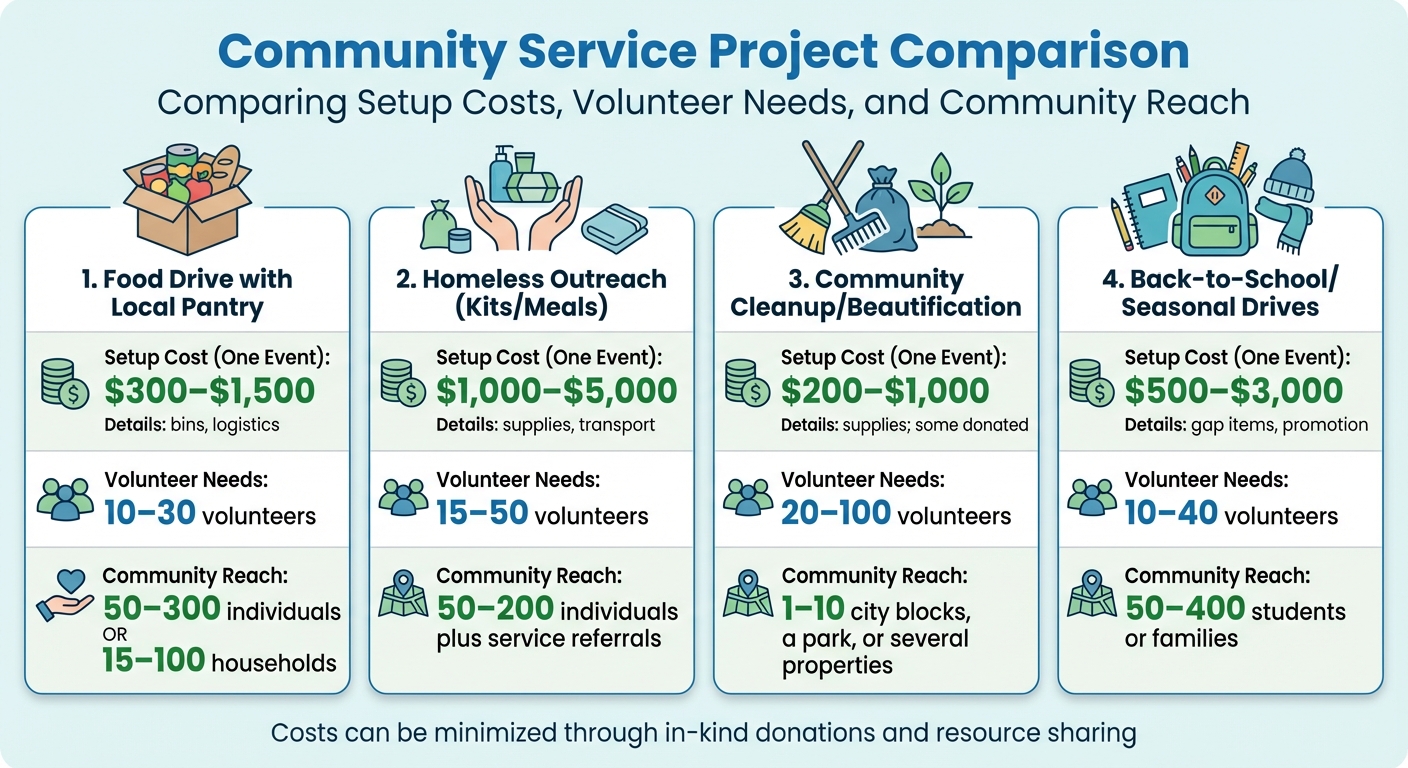
Community Service Project Comparison: Costs, Volunteers, and Impact
When forming a partnership, the real impact comes from launching programs that combine the strengths of both groups to serve the community effectively. Churches bring volunteer networks, trusted community relationships, and physical spaces, while nonprofits contribute expertise in program design and social services. Together, they can create initiatives that make a meaningful difference.
Community Service Projects
Joint service projects are a practical way to start collaborating. These might include food drives, homeless outreach, community cleanups, or seasonal efforts like back-to-school supply collections. These types of programs are relatively simple to organize, appeal to a wide range of volunteers, and often have a visible impact on the community.
For example, food drives tied to holidays or the school year can run for a few weeks, aiming to collect specific amounts of food for local families. Homeless outreach events, held monthly or quarterly, might provide hygiene kits, meals, and referrals to services. Cleanups or beautification projects can improve public spaces like parks, schools, or senior centers, either as one-time events or biannual efforts.
Here’s a quick comparison of these projects based on costs, volunteer needs, and community impact:
| Program Type | Setup Cost (One Event) | Volunteer Needs (Per Event) | Community Reach (Per Event) |
|---|---|---|---|
| Food drive with local pantry | $300–$1,500 (bins, logistics) | 10–30 volunteers | 50–300 individuals or 15–100 households |
| Homeless outreach (kits/meals) | $1,000–$5,000 (supplies, transport) | 15–50 volunteers | 50–200 individuals plus service referrals |
| Community cleanup/beautification | $200–$1,000 (supplies; some donated) | 20–100 volunteers | 1–10 city blocks, a park, or several properties |
| Back-to-school/seasonal drives | $500–$3,000 (gap items, promotion) | 10–40 volunteers | 50–400 students or families |
Costs can be minimized through in-kind donations from local businesses or city partnerships, as well as by sharing resources like facilities and communication channels. A clear division of roles is key: nonprofits should manage program design, volunteer training, and risk management, while churches focus on recruiting volunteers, promoting events locally, and providing pastoral care during activities.
Educational and Support Programs
Once service projects are established, educational initiatives can take the partnership to the next level. Programs like tutoring, youth mentoring, financial literacy workshops, and support groups address deeper community needs and align with both organizations' missions.
For instance, after-school tutoring can use church classrooms, with nonprofits supplying trained volunteers and aligning the curriculum with local school programs. These sessions work best as recurring series over six to 12 weeks, with simple tools to track progress. Similarly, youth mentoring programs can be hosted at the church but operate under the nonprofit's established safeguarding protocols.
Workshops on topics like budgeting, resume writing, or parenting can be particularly impactful when paired with childcare and hospitality provided by the church. The nonprofit can bring in structured curricula and trained facilitators to ensure effective delivery.
To make these programs accessible, adopt trauma-informed practices by keeping schedules predictable, maintaining privacy, and using inclusive language. Avoid proselytizing in secular or publicly funded programs, and be clear about when activities are faith-based. Offering language support and scheduling events around work and school hours can also help broaden participation.
Events and Fundraisers
Large-scale events offer another way to engage the community and mobilize resources. Collaborative efforts like charity fairs, resource days, or digital fundraising campaigns can draw in more participation and funding than either partner could achieve alone.
Charity fairs, for example, might feature booths offering health screenings, legal advice, and family-friendly activities. Nonprofits can organize programming while churches provide the venue and volunteers. Service Sundays dedicate an entire day to activities like food packing or neighborhood improvements, bringing the community together in a hands-on way.
Digital fundraising campaigns are another powerful tool. Nonprofits can handle donation processing, while churches amplify outreach through storytelling, video testimonials, and social media promotion. After these events, sharing impact metrics and success stories during worship services or community meetings can help sustain volunteer enthusiasm and donor loyalty.
If your partnership is planning a major fundraising event and needs help with promotion, donor acquisition, or retention strategies, consider reaching out to Share Services (https://shareservices.co). They specialize in marketing and fundraising solutions for nonprofits with revenues between $1 million and $20 million, offering expertise in areas like digital campaigns and donor retention.
sbb-itb-deea482
Running Collaborative Fundraising Campaigns
Collaborative fundraising combines the strengths of churches and nonprofits to maximize financial outcomes. Churches bring their dedicated volunteer base and community trust, while nonprofits contribute their expertise in fundraising systems and compliance. However, success hinges on careful planning and effective digital strategies.
Planning and Hosting Joint Events
Kick off any joint fundraising campaign with a shared vision session where both teams align on goals. For example, if the aim is to raise $50,000 for a specific program, clearly outline responsibilities and document them in a concise plan. This step helps avoid common challenges like disputes over control, convenience, or credit.
Create a timeline with key milestones: announce the event 8–10 weeks in advance, ramp up promotion 4–6 weeks before, train volunteers 1–2 weeks prior, host the event, and hold a debrief within two weeks. Budget carefully, accounting for costs like food, printing, digital ads, payment processing fees (typically 2.5–3% of donations), and audiovisual needs.
Popular joint event ideas include:
- Charity dinners: Host in the church fellowship hall, with the church providing space and volunteers while the nonprofit shares impact stories and makes the giving appeal.
- Silent or live auctions: Encourage donations from church members and local businesses. Use mobile bidding to involve those who can't attend in person.
- "Serve and give" days: Pair hands-on activities, like assembling care kits, with a short giving appeal to show donors the immediate impact of their contributions.
Decide early which organization will handle funds and issue tax receipts. If revenue will be shared, agree on a straightforward formula, such as 80% of net proceeds for the nonprofit program and 20% for the church's outreach budget. Document these arrangements and share them with staff and volunteers to ensure everyone is on the same page.
Once the event wraps up, shift your focus to digital fundraising to extend the campaign's reach.
Digital Fundraising Strategies
Joint events set the stage, but digital platforms help sustain momentum. Start by creating a co-branded landing page on the nonprofit’s website. This page should highlight the church partnership, show clear donation tiers, explain the impact of gifts, and offer recurring donation options. Use language that resonates with churchgoers while maintaining the nonprofit’s messaging.
Coordinate email and SMS campaigns to deliver messages from both organizations within the same week but with distinct focuses. For instance, the church might highlight spiritual motivations and local impact, while the nonprofit emphasizes program outcomes and tax benefits. Provide ready-made graphics, videos, and captions for church staff to share on social media, broadening your community reach.
Eligible 501(c)(3) nonprofits can take advantage of Google Ad Grants, which offer up to $10,000 per month in free search ads. Use keywords that tie your cause to faith-based giving, like “Christian food pantry volunteer” or “church mission support [your city].” Monitor performance metrics like click-through rates and conversions, and adjust your ad copy to improve results. This tool can significantly boost traffic to your campaign landing page.
For nonprofits with annual revenues between $1 million and $20 million, Share Services offers specialized marketing and fundraising solutions. Their team can craft co-branded messaging, design campaigns around key church dates like Easter or Thanksgiving, and manage paid ads targeting likely givers. Their Strategy Retainer starts at $3,500 per month and includes weekly strategy sessions and KPI reporting. Paid media services, starting at $1,500 per month, cover platforms like Meta Ads and Google Ad Grant management.
"Share helped us test simplified + focused messaging that improved our conversion rates. Additionally, paid display ad retargeting was successful, and the recurring giving pop-up brought us almost 100 new monthly gifts. We've continued to see success with both of these strategies in other campaign efforts." - Jasmine Morse, Advancement Department
Donor Retention and Data Sharing
Ethical handling of donor data is essential for maintaining trust. Before launching a campaign, decide in writing who will be the "donor of record" (the nonprofit, the church, or both), what data will be shared (e.g., name, email, postal code, gift amount), and how each organization can communicate with donors afterward.
Ensure all forms explicitly state which organization will follow up, and offer separate opt-in options for the church and nonprofit. Never share donor information without permission, and limit data sharing to what’s necessary - like receipts, impact updates, and related appeals. These terms should be documented in a Memorandum of Understanding.
To keep donors engaged, send thank-you messages within 24–72 hours that reference the event or campaign. Within 30–90 days, share tangible results, such as the amount raised or the number of families helped. A joint follow-up sequence could include a thank-you email from the pastor, a story from the nonprofit, and an invitation to volunteer or attend another event.
"Reactivation is cheaper than acquisition. Email can be effective, but multi-channel approaches are even better. We did this with Focus and saw great results for them." - Eddie Laing, Paid Media Specialist
Encourage one-time donors to become long-term supporters by featuring recurring giving options prominently on your donation pages. A simple pop-up asking donors to “make this monthly” can work wonders. Develop a follow-up plan that combines impact stories, volunteer opportunities, and non-financial ways to stay involved. By honoring donor preferences and communicating transparently, you build the trust needed for lasting partnerships.
Measuring Partnership Success
Tracking the success of your collaborative programs and campaigns is essential for reinforcing the impact of your partnership. Once joint initiatives are launched, it’s important to measure what’s working. This helps keep both parties accountable and aligned. Success isn’t just about attendance numbers or funds raised - it also includes the broader impact on your mission and the overall health of the partnership. Partners who set clear goals from the start and revisit them regularly tend to build stronger, more enduring collaborations.
Key Performance Indicators (KPIs)
To effectively measure nonprofit–church collaborations, focus on four main categories of KPIs:
- Reach and Service Delivery: Monitor how many individuals or households are served, track demographic details, measure repeat participation, and calculate program completion rates. For example, you might aim for a 25% increase in families receiving ongoing support within a year or set a goal for 50 congregants to contribute 10 volunteer hours annually.
- Financial Impact: Evaluate metrics like total funds raised (in USD), average donation size, number of new donors, percentage of church attendees contributing, and the cost per dollar raised.
- Volunteer Engagement: Keep an eye on the number of volunteers, total hours contributed, retention rates, and how many church members are actively involved.
- Quality and Satisfaction: Gather participant feedback using a 1–5 scale or Net Promoter Score–style questions, such as, “How likely are you to recommend this program to a friend?” Collect qualitative stories that highlight personal transformations.
Church-specific indicators, like increased small group participation among volunteers or heightened awareness of local needs, can also reflect the partnership’s mission-driven impact - even if service numbers are modest. Including these KPIs in your Memorandum of Understanding ensures both partners are clear on who will collect data, how it will be reported, and what success looks like.
Tools for Monitoring Progress
Once your KPIs are established, use straightforward tools to track progress. For smaller organizations, simplicity is often the best approach. Sign-in sheets or digital forms at events can help you log attendance, volunteer hours, and participant demographics. Post-event surveys - whether on paper or online - are great for capturing satisfaction scores and personal stories.
Many partnerships use CRM platforms to manage data like donations, attendance, and volunteer hours. These systems allow for shared reporting while safeguarding sensitive information through role-based access. If a full CRM feels too complex, you can combine online survey tools, cloud-based spreadsheets for tracking attendance and hours, and accounting software for monitoring revenue and expenses.
Consider creating a shared dashboard that’s updated monthly or quarterly with easy-to-read KPI charts. This makes it simple for both leadership teams and congregations to review progress. For nonprofits with annual revenues between $1 million and $20 million, Share Services offers project management and KPI reporting through their Strategy Retainer (starting at $3,500 per month). This includes weekly strategy sessions and analytics dashboards for digital campaigns. These tools integrate seamlessly with earlier strategies, ensuring that your digital fundraising efforts and joint events continue to make a meaningful impact in the community.
Regularly review the data by scheduling quarterly check-ins for active programs and a more detailed annual review to analyze trends, participant stories, and strategic alignment. These meetings should cover KPI achievements, participant and volunteer feedback, financial outcomes, operational challenges (like scheduling or communication issues), and any new community needs or shifts in church priorities. Using a consistent agenda and shared dashboard keeps these discussions focused on learning and adapting rather than assigning blame. Celebrate successes publicly - whether during a church “celebration Sunday” or in your nonprofit’s annual report - to encourage ongoing engagement and accountability.
Maintaining and Scaling Partnerships
Once you've gained momentum, the next step is to maintain and thoughtfully grow the partnership. Long-term collaborations often falter when communication becomes sporadic or expectations aren't clearly defined. Partnerships that thrive for three to five years - or even longer - depend on consistent communication, shared objectives, and mutual successes that benefit both the congregation and nonprofit stakeholders. Many successful collaborations include quarterly check-ins and at least one in-person vision meeting annually. These meetings help ensure alignment and address any new challenges that arise. These foundational practices set the stage for the reviews and scaling strategies outlined below.
Annual Reviews and Feedback Loops
An annual review is key to keeping the partnership on track. Use it to evaluate both measurable outcomes and qualitative feedback. Discuss what went well, pinpoint issues like scheduling conflicts or communication gaps, and adjust the Memorandum of Understanding (MOU), budget, or calendar as needed for the next year. Including at least one board member or senior leader from each organization ensures decisions are actionable. Beyond the annual review, establish an ongoing feedback loop by designating a liaison from each side to connect monthly. After major joint events, hold a 30–45 minute debrief with staff and key volunteers to capture lessons while they're still fresh.
Celebrate joint accomplishments regularly. Experts also recommend documenting roles, communication schedules, and procedures for resolving issues. Revisit this document annually to ensure it stays relevant.
When review processes are running smoothly, you can explore ways to scale the partnership. Scaling can happen in two ways:
- Vertically: Deepen the collaboration with a single congregation. For example, evolve from a one-time service day to quarterly projects, ongoing support groups, or joint fundraising efforts.
- Horizontally: Expand into a coalition of multiple faith-based organizations. This approach allows you to pool resources like volunteers, funding, and facilities for a broader impact.
Before scaling, make sure your nonprofit has the necessary infrastructure in place. This includes a designated contact for faith-based partners, a clear MOU template, effective volunteer management systems, and reliable data tracking to measure joint outcomes.
Getting Professional Support
When managing multiple partnerships becomes overwhelming, it might be time to bring in professional support. Share Services offers marketing and fundraising solutions tailored specifically for nonprofits with annual revenues between $1 million and $20 million. These services are designed to help organizations build the capacity needed to scale partnerships effectively. Their offerings include digital fundraising strategies, donor retention programs, new donor acquisition, and digital advertising - all of which can align with church calendars and joint events.
For example, Share Services can create co-branded campaign pages for joint initiatives, design segmented email journeys for congregants, and run retargeting ads to encourage recurring monthly donations. Their Strategy Retainer, starting at $3,500 per month, provides access to a dedicated nonprofit strategist, weekly strategy sessions, detailed project management, and KPI reporting. These services integrate seamlessly with your quarterly check-ins and annual reviews.
"On our project, it would have taken me half a year, and Share was able to do it in a couple of months. And that's something we wouldn't have been able to do with our small staff." - Kyle Birch, Director of Communications
Conclusion: The Potential of Nonprofit-Church Partnerships
Partnerships between nonprofits and churches have the power to create a meaningful difference by combining shared values, open communication, and thoughtful planning. This guide has highlighted key elements for success: aligning missions to build a strong foundation, using formal agreements like MOUs to avoid misunderstandings, and maintaining regular feedback to keep partnerships thriving. Churches bring passionate volunteers, community connections, and physical spaces, while nonprofits contribute structured programs and operational expertise. Together, they can achieve results that would be out of reach individually.
To get started, focus on identifying local partners whose missions align with yours. Begin with a specific project - such as a service day, food drive, or after-school program - that can build trust and provide a chance to evaluate your collaboration. From the beginning, prioritize open dialogue and shared decision-making to create a strong, lasting partnership.
Regular check-ins and annual reviews are essential to staying on track, celebrating achievements, and demonstrating impact to both congregations and donors. These milestones not only strengthen the partnership but also highlight the value of the collaboration to key stakeholders.
When expanding these efforts, professional assistance can help boost digital fundraising and donor engagement. Share Services specializes in digital fundraising, donor retention strategies, and marketing solutions for organizations with revenues between $1 million and $20 million, helping you amplify your partnership’s impact and broaden your mission’s reach.
Ultimately, successful partnerships view collaboration as a long-term investment in community well-being, creating networks of support that deliver stronger, more effective care to those who need it most.
FAQs
How can nonprofits and churches build a partnership that feels equal and collaborative?
For nonprofits and churches to build a strong, collaborative partnership, the first step is to clearly define shared goals and outline the roles each party will play. This clarity ensures that everyone is on the same page from the start.
Maintaining open and consistent communication is just as important. Regular check-ins and honest feedback sessions allow any issues to be addressed early, helping to keep the partnership balanced and productive. When mutual respect and a cooperative mindset are prioritized, both organizations can work together seamlessly, ensuring neither overshadows the other.
How can nonprofits and churches effectively resolve conflicts during collaboration?
To handle conflicts effectively, it’s essential to encourage open and honest communication from the outset. Clearly outlining roles, responsibilities, and expectations can go a long way in preventing misunderstandings. Regular check-ins provide an opportunity to address any concerns early, keeping small issues from turning into larger problems.
When conflicts do occur, involve all parties in the decision-making process and aim to find solutions that align with the shared goals. If tensions run high, bringing in a neutral mediator can help guide discussions and ensure everyone feels heard. At the heart of conflict resolution is building mutual respect and understanding, which strengthens the foundation of any successful collaboration.
What are some effective ways nonprofits can evaluate the success of their partnerships with churches beyond financial outcomes?
Nonprofits can evaluate the effectiveness of their church partnerships by keeping an eye on engagement metrics. This includes tracking things like more volunteers stepping up, greater attendance at events, and increased activity on social media platforms. These indicators reveal how well the partnership is resonating with the community.
Another key area to monitor is donor behavior. Look at how well you're retaining existing donors and whether you're attracting new supporters. These figures can shed light on the partnership's overall influence.
It's also essential to assess the wider community impact. This might involve observing increased awareness of your mission, noticeable improvements in community programs, and the development of the partnership itself over time. Together, these elements offer a well-rounded view of success that goes beyond just financial outcomes.
Related Blog Posts
Get helpful resources, straight to your inbox
We love sharing tools, ideas, and stories that make nonprofit work a little lighter and a lot more effective. Sign up below and we’ll send you practical tips, free resources, and a bit of encouragement—because the work you’re doing matters.
No spam. Just good stuff for good people.