
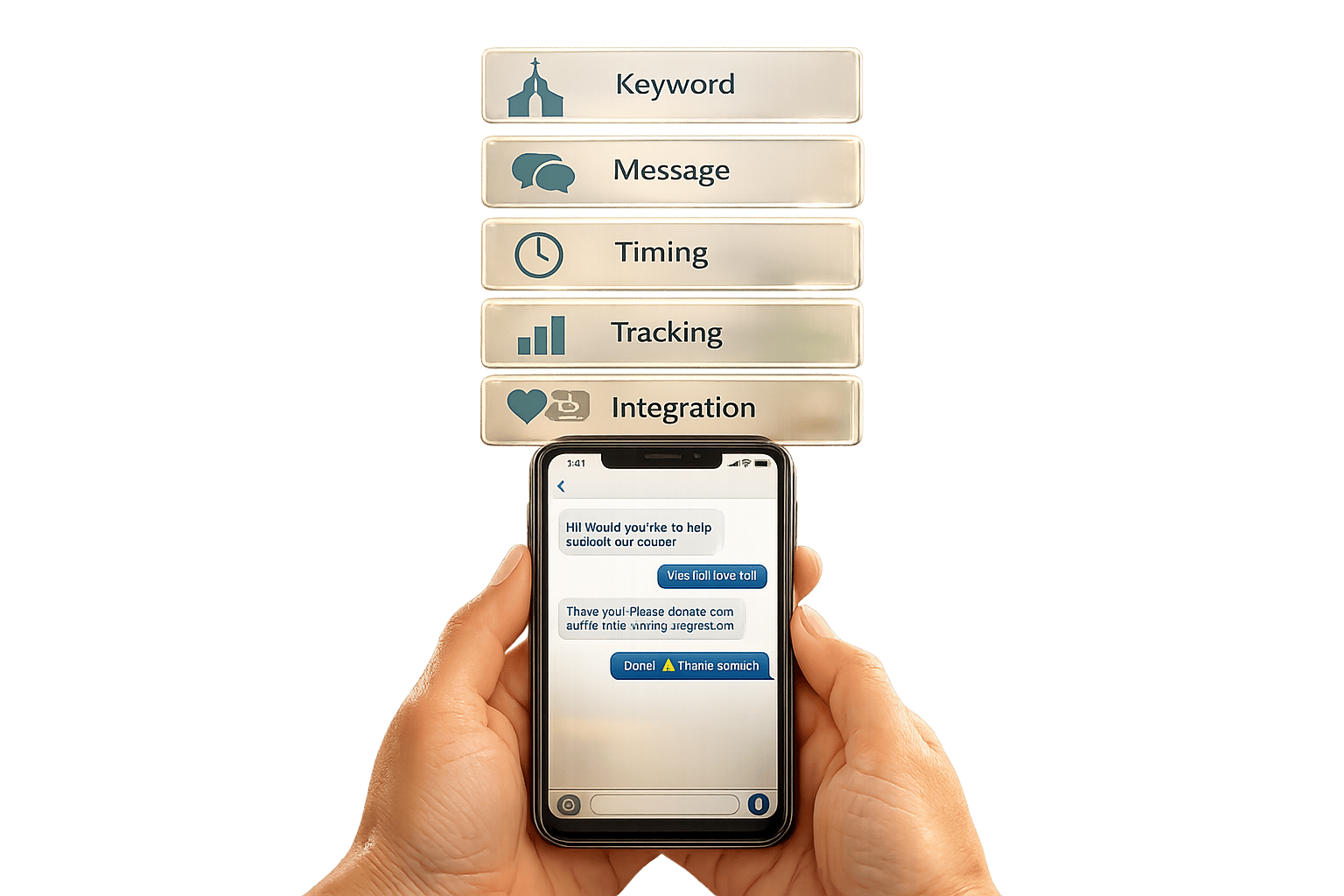
Feb 16, 2026
Ultimate Guide to SMS Fundraising
SMS fundraising is one of the most effective ways to connect with donors quickly and drive donations. With a 98% open rate and 90% of texts read within 3 minutes, text messaging outperforms email in engagement and revenue generation. Churches and ministries, in particular, benefit from this method, as it allows supporters to donate instantly during emotional moments, like a moving sermon or a call to action.
Here’s what you need to know about SMS fundraising:
- How it works: Donors text a keyword (e.g., “GIVE”) to a short number and complete their donation via a secure link.
- Why it’s effective: Higher open and conversion rates compared to email, with organizations earning $92 per 1,000 texts sent.
- Benefits: Quick donations, recurring gift options, and branded donation pages that increase trust.
- Legal compliance: Adhere to rules like obtaining consent, honoring opt-outs, and following quiet hours to avoid penalties.
- Campaign setup: Choose memorable keywords, craft clear messages, and integrate SMS with email and social media for better results.
Whether you’re new to SMS or refining your approach, this guide provides actionable steps to boost donations and build stronger donor relationships.
Why and How to Set Up Text to Give for Nonprofits (Fast & Easy!) | Funraise Mobile Fundraising Guide
sbb-itb-deea482
What is SMS Fundraising?
SMS fundraising is a way for donors to give by simply sending a text message. By texting a keyword like "GIVE" or "HOPE" to a specific phone number, supporters can quickly complete their donation through a secure, mobile-friendly link.
This method works because it’s straightforward and fits into people’s everyday habits. With fewer than 10% of church attendees carrying cash and less than 2% using checks, text giving allows churches to meet donors where they already are - on their phones. Whether sitting in a pew, watching a livestream, or responding to an appeal from home, supporters can contribute with ease.
Now, let’s break down how SMS fundraising actually works and how it has evolved over time.
How SMS Fundraising Works
There are two main ways SMS fundraising operates, and they’ve changed significantly over the years.
-
The old way: Text-to-give
Donations were added directly to a donor’s mobile phone bill. While simple, this method had limitations. Donations were capped at $5–$10, and it could take 30–60 days for the funds to reach the organization. Most churches have moved away from this outdated system. -
The modern way: Text-to-donate
This updated approach is faster and more user-friendly. Here’s how it works: when someone texts your keyword to a short code (or 10-digit number), they receive an automated reply with a link to a mobile-optimized donation page. This page, branded with your church’s logo, allows donors to give custom amounts, set up recurring gifts, and pay instantly through credit cards or digital wallets. Plus, payouts are processed within 2–5 business days.
Branding plays a big role in encouraging donations. In fact, donors are seven times more likely to give when they see your church’s branding on the donation page.
Why SMS Works for Churches and Ministries
SMS fundraising fits naturally into church communications. You can display your text-to-donate keyword and number on screens during services, include them in weekly bulletins, or highlight them during special campaigns like disaster relief efforts or building fund drives. It’s a way to capture the moment when someone feels inspired to give.
"SMS fundraising allows you to reach people instantly with time-sensitive information. A donor can learn about and donate to a cause in less than a minute." – Kathleen Crampton, EZ Texting
The effectiveness of SMS is backed by data. Text messaging boasts a 25% conversion rate for nonprofits. When paired with email campaigns, organizations can see a 30% increase in revenue raised per person. This is especially impactful for faith-based groups, which receive about 29% of all charitable contributions in the U.S. The average churchgoer donates roughly $17 per week, or $884 annually. By enabling recurring donations, SMS fundraising helps ensure steady support - something the old carrier-billed systems couldn’t offer.
Benefits of SMS Fundraising
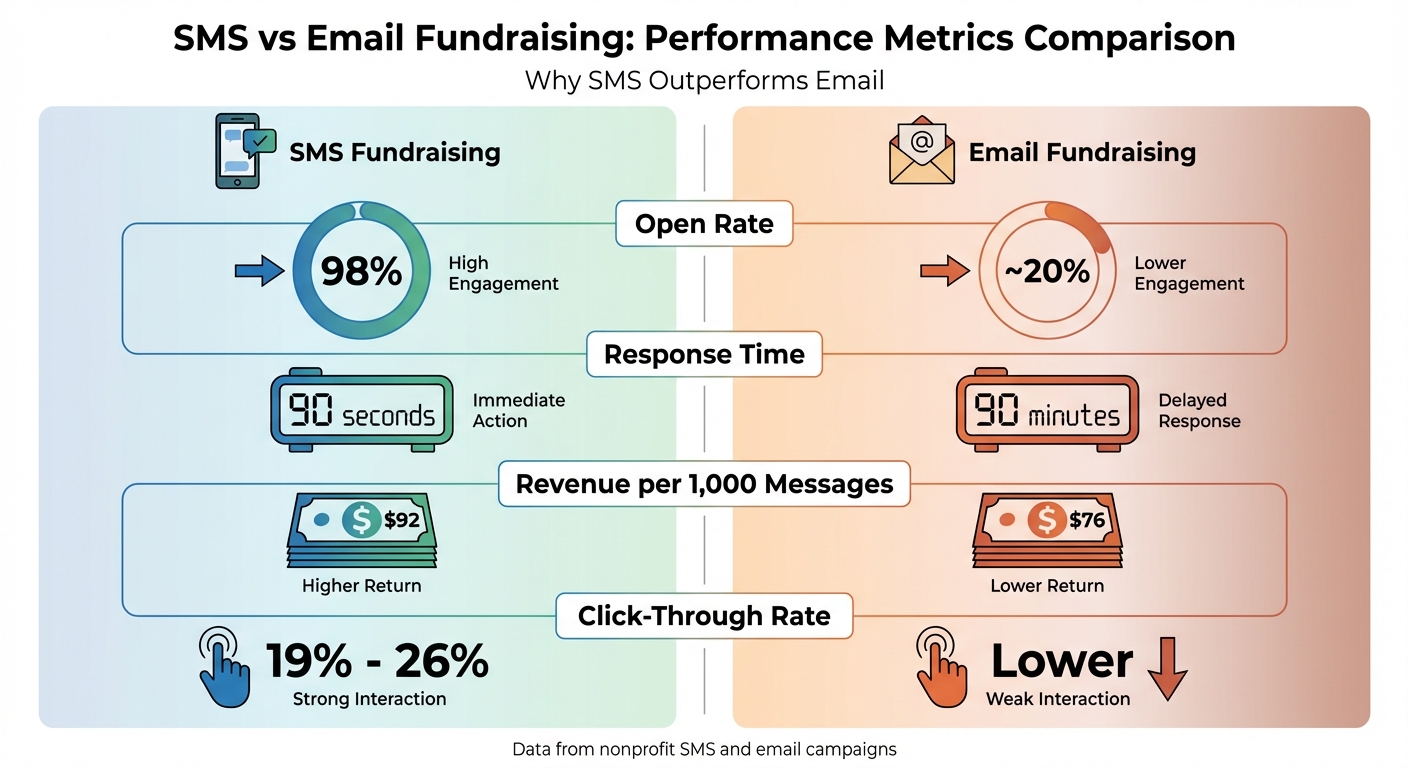
SMS vs Email Fundraising Performance Comparison
Following our discussion on how SMS fundraising works, let’s dive into its standout advantages. With its high open rates and quick response times, SMS fundraising outshines traditional channels by driving stronger donor engagement, cutting costs, and extending reach.
Higher Donor Engagement Rates
SMS fundraising thrives on its ability to create personal, direct communication with donors. This connection feels more intimate, which is especially beneficial for churches and ministries aiming to foster a sense of community. The numbers back this up: SMS campaigns often achieve click-through rates between 19% and 26%, with conversion rates hovering around 25%. But it’s not just about one-time donations - SMS enables two-way interactions, such as responding to prayer requests, organizing volunteers, or sending event reminders. These features help strengthen relationships with donors over time.
Lower Costs and Better ROI
When it comes to cost-effectiveness, SMS fundraising delivers impressive financial results without breaking the bank. Many organizations report an average return on investment of 500%. On top of that, the average donation amount for text-to-donate campaigns is around $107 - a far cry from the $5–$10 limits of older carrier-billed systems. Costs typically include platform fees, per-message charges (with MMS being slightly more expensive), and standard card processing fees (usually 2–3% plus a small transaction fee). Additional costs, such as fees for dedicated short codes or multiple keywords, may also apply. Still, the financial upside makes SMS a smart choice for budget-conscious fundraising.
Wider Reach and Faster Response
SMS fundraising ensures your message gets seen, no matter where your supporters are. Mobile giving donations have skyrocketed by over 205% in the past year, largely due to the ease of donating via smartphones. Unlike physical addresses, mobile numbers often stay the same even when people move or change jobs, making SMS a more consistent way to stay in touch. This makes it especially powerful for time-sensitive campaigns, such as disaster relief efforts or matching gift promotions. Paired with real-time progress updates, text appeals can inspire donors to act quickly - sometimes completing donations in under 90 seconds.
Here’s a quick comparison of SMS performance metrics versus email marketing:
| Metric | SMS/Text Messaging | Email Marketing |
|---|---|---|
| Open Rate | 98% | ~20% |
| Response Time | 90 seconds | 90 minutes |
| Revenue per 1,000 Messages | $92 | $76 |
| Click-Through Rate | 19%–26% | Lower |
Legal Requirements and Compliance
Understanding and adhering to legal requirements is just as important as crafting your campaign strategy. Compliance not only protects your donors but also safeguards your ministry's reputation. Before launching an SMS fundraising campaign, it's crucial to address these legal considerations. The Telephone Consumer Protection Act (TCPA) classifies marketing and fundraising texts as "calls", making them subject to strict consent and disclosure rules. Violating the TCPA can result in penalties of $500 per message, or $1,500 per message for willful violations. With no cap on damages, a single non-compliant campaign sent to 10,000 recipients could lead to $5 million to $15 million in potential liability.
TCPA and Opt-In Rules
To send fundraising or promotional texts, you must obtain documented prior express written consent. For informational messages - like donation receipts or event reminders - only "prior express consent" is required, which has less stringent requirements.
Your opt-in forms should clearly disclose key details, such as your organization's name, the inclusion of fundraising content, the expected message frequency (e.g., "up to 4 msgs/mo"), a note that "Msg & data rates may apply", and a statement clarifying that consent is not a condition of donation. Using a double opt-in process is highly recommended. After someone provides their number, send a confirmation text asking them to reply "YES" to verify their consent. This adds an extra layer of protection by creating a robust consent record.
Keep detailed consent records - such as timestamps, IP addresses, and opt-in text - for at least four years to comply with the TCPA's statute of limitations. Since hundreds of thousands of mobile numbers in the U.S. are reassigned or deactivated every month, maintaining accurate records is essential for staying compliant.
How to Stay Compliant
Compliance requires ongoing vigilance and adherence to specific practices. Start by respecting quiet hours - federal law prohibits sending texts before 8:00 a.m. or after 9:00 p.m., and some states have even stricter limits (e.g., 8:00 a.m. to 8:00 p.m.).
Every message should include a clear opt-out option, such as "Reply STOP to opt out." Regularly scrub your donor lists against the National Do Not Call Registry and use the FCC's Reassigned Numbers Database every 31 days. Additionally, beginning April 11, 2025, opt-out requests must be honored within 10 business days. Make sure your platform automatically recognizes opt-out keywords like STOP, QUIT, CANCEL, and UNSUBSCRIBE.
"Compliance doesn't slow fundraising down. It protects trust - and trust is what drives results." - Rally Corp
Avoid using purchased or shared donor lists, as consent is typically non-transferable between organizations and poses significant risks. Complete 10-Digit Long Code (10DLC) registration to verify your organization with carriers. This process improves message deliverability and reduces the likelihood of being flagged as spam. Lastly, ensure your website includes a privacy policy explicitly stating that donor data and mobile numbers will not be shared with third parties for marketing purposes.
How to Set Up SMS Fundraising Campaigns
Ready to launch an SMS fundraising campaign? Here's how to make it happen step by step. Start by selecting a PCI-compliant platform that works seamlessly with your church management system, like Planning Center or Bloomerang. This ensures donor data syncs automatically, saving you time and effort. Then, set clear and measurable goals - something like, "Raise $10,000 for the youth mission trip by March 1st."
Before going live, test everything on both iOS and Android devices to catch any autocorrect mishaps, broken links, or formatting glitches. Set up automated thank-you messages with a follow-up story or video showing the impact of donations within a week. Finally, make sure every aspect of your campaign, from keywords to message timing, is carefully thought out.
Selecting Keywords and Short Codes
Keywords are the heart of SMS fundraising. Donors text these words to your short code (a 5- or 6-digit number) to kick off the donation process. Keep your keyword short (seven characters or less) and simple to spell. Words like "GIVE", "HOPE", or "YOUTH" are great choices because they’re easy to remember and pronounce during announcements. Avoid using special characters or spaces, as these can lead to technical hiccups.
Your keyword should connect emotionally to your cause. For instance, The Salvation Army Great Lakes Division uses specific keywords like "SHOES" to tie directly to their footwear charity. Christina Holman, their Director of Integrated Marketing and Mail, shares:
"I know the media really appreciates it because it's really easy to say during an interview."
Before finalizing your keyword, test it on multiple phones to ensure it doesn’t autocorrect to something unintended. Say it out loud too - does it sound clear and straightforward?
| Keyword Type | Good Examples | Examples to Avoid | Why? |
|---|---|---|---|
| Name-Based | MARTIN | MARTINNATURECENTER | Short and easy to type |
| Mission-Based | BREAD, SHOES | DONATE, HELP | Specificity builds connection |
| Event-Based | FOLK, GALA | LIVE4NATURE | Avoid numbers or confusing terms |
Once you've picked your keyword, promote it everywhere - on Sunday service slides, livestreams, social media, email signatures, and printed materials. Darryl Carnley from My360Project highlights:
"The biggest thing is to get your staff and everybody on board so everything - your branding, everything - can have 'Text SHOES to 24365' on it."
Now that your keyword is set, focus on crafting messages that encourage immediate action.
Writing Effective Text Messages
Text messages work because they’re short, direct, and personal. Keep your initial appeal under 160 characters for standard SMS, or under 250 characters if linking to a mobile-friendly donation page. Think of each message as a "mini billboard" - you only have a few seconds to grab attention and inspire action.
Every message should include three elements: the problem, the solution, and a clear call to action. For example: "Families in our community are facing hunger this winter. Your gift today provides warm meals. Text FEED to 12345 to give now." Focus on donor-centric language, using "you" rather than "we", which makes the donor feel like the hero of the story. When possible, personalize messages with the donor's first name to strengthen the connection.
Create urgency with time-sensitive calls to action, like "Text by midnight to meet our matching gift goal" or "We’re $2,000 away from our goal - can you help us close the gap?" To make your messages even more engaging, consider using MMS to include photos or videos that show the impact of your work. These visuals can significantly boost engagement compared to plain text. Always include one clear action and an easy-to-access URL to keep things simple for donors.
When and How Often to Send Messages
Timing is everything. Send messages between 9:00 a.m. and 8:00 p.m. to stay within legal guidelines and hit peak engagement times. Lunchtime and late afternoons often see the best response rates.
Be mindful of frequency - stick to 2–4 messages per month. This keeps your organization top-of-mind without overwhelming donors, which could lead to opt-outs. Use a strategic sequence: start with an initial appeal, follow up 4–6 hours later with a reminder for those who clicked but didn’t complete their donation, send an instant thank-you message, and within 30 days, share an update on how their gift made a difference.
With 98% of text messages opened and 90% read within the first three minutes, timing and frequency can make or break your campaign. In 2023, SMS fundraising generated an average of $92 for every 1,000 messages sent. Plus, organizations that combined SMS with email saw a 30% boost in revenue per donor. These stats highlight just how powerful SMS can be when done right.
Combining SMS with Other Fundraising Channels
SMS works wonders when paired with email, social media, and other digital tools. Organizations running multi-channel campaigns see higher revenue and build a stronger connection with their supporters. The trick lies in understanding what each channel does best and using them together. This strategy takes advantage of SMS's quick response times and high engagement, amplifying its impact through coordinated efforts.
Using SMS with Email and Social Media
Email shines when delivering detailed content like newsletters, impact stories, or event updates. On the other hand, SMS is perfect for urgent messages, reminders, or quick calls to action. Pairing these two creates a powerful combo. For instance, you might send an email sharing details about an upcoming mission trip and follow it up with a text:
"Did you catch our email about the mission trip? We're almost at our goal! Donate now: [link]."
The HEADstrong Foundation uses this strategy effectively, sending texts with links to important emails so supporters can quickly access them on their phones. As James Martin, Founder of Rally Corp, explains:
"If somebody was really busy or maybe it got lost in the sauce in their inbox, they can catch that email and get it right on their phone".
Social media adds another layer. Use SMS to guide donors to your social posts for immediate engagement. For example:
"We just posted a video about how your donations are changing lives. Watch it here: [Facebook link]."
This ensures your content reaches your most engaged supporters. You can also grow your SMS list by promoting opt-ins on social platforms with messages like, "Want updates in real time? Text HOPE to 12345 to join our VIP list."
UNICEF provides a great example of this multi-channel approach. Over three months, they partnered with Infobip to integrate SMS, email, and WhatsApp. By centralizing donor data and automating messages like welcomes and thank-yous, they increased regular donors by 7.8% and reduced donor churn by 33.3% compared to the previous year. Their success came from treating these channels as pieces of a unified donor journey, not separate efforts.
For campaigns like Giving Tuesday, align your messaging across platforms. Start with a detailed email, follow with eye-catching social posts, and finish with SMS reminders. Email handles storytelling, social media grabs attention with visuals, and SMS delivers timely nudges. Now, let’s explore how SMS can keep donors engaged beyond the initial appeal.
SMS for Keeping Donors Engaged
SMS isn't just for fundraising - it’s a fantastic way to build lasting relationships with your supporters. Use texts to share updates, thank donors, and tell impact stories that show how their contributions make a difference. Organizations that send cultivation texts before a fundraising ask see a 54% increase in average gift size. Why? Because donors feel appreciated and connected to the mission, not just seen as a source of funds.
Balance your approach by mixing content. For every fundraising request, send two to three non-ask messages. These could be a photo from a recent event, a quick project update, or a simple "thank you" on the anniversary of their first gift. As Frank Mumford, CFRE at Gravyty, puts it:
"If you only use a channel to solicit, then your donors will tune out over time and will be less likely to engage with you via that channel".
Personalization is key. Connect your SMS platform to your CRM so messages are tailored to each donor's giving history, location, or interests. For example, if someone supported your food pantry last year, you might text them in November:
"Hi [Name], last Thanksgiving you helped feed 50 families. This year, we’re aiming even higher. Can we count on you again?"
This level of thoughtfulness shows you value their past support and encourages them to stay involved.
Two-way communication takes this even further. Use platforms that allow replies so donors can ask questions or share feedback. If someone texts back asking about your mission trip, responding personally turns the interaction into a meaningful conversation. With SMS boasting response rates as high as 45%, this creates opportunities for engagement that email or social media often can’t.
Make your SMS list feel exclusive by sharing updates with recurring donors before going public. Give them sneak peeks of new projects or special milestones. Treat this channel as a VIP space for your most loyal supporters. When donors see the direct impact of their contributions through timely, personal updates, they’re more likely to stay connected. These efforts not only improve retention but also strengthen your overall SMS fundraising strategy, creating a cycle of ongoing support and engagement.
Tracking SMS Campaign Performance
Running SMS campaigns without monitoring their performance is like navigating without a map - you're bound to get lost. Tracking data is essential for understanding what’s effective and what’s not. Faith-based nonprofits that keep an eye on their metrics often see better results and stronger connections with donors. The good news? Most SMS platforms offer real-time tracking, making it easier to measure success. With the right data, everything from keyword choices to scheduling can be fine-tuned for maximum impact. Let’s dive into the key metrics that can guide your SMS campaigns.
Important Metrics to Monitor
Start with open rates - the percentage of recipients who read your messages. SMS boasts an impressive 99% open rate, with 90% of texts opened within just three minutes. Compare that to nonprofit emails, which average between 20% and 28.6%, and you can see why SMS is so effective.
Next, look at your click-through rate (CTR), which measures the percentage of recipients who click on links in your messages. It’s calculated by dividing the number of clicks by the number of delivered texts, then multiplying by 100. The average CTR for text marketing is around 19%. If yours is lower, it might be time to reevaluate your call-to-action or tweak where your links appear.
The conversion rate is another key metric. This shows the percentage of recipients who take a desired action, like making a donation. To calculate it, divide the number of actions by the total messages sent, then multiply by 100. SMS campaigns typically see 25% higher conversion rates compared to other digital channels. You can also track your average donation amount by dividing total revenue by the number of donations. This helps you gauge whether your suggested donation amounts are hitting the mark.
Keep an eye on your opt-out rate as well. This is calculated by dividing the number of unsubscribes by the total recipients and multiplying by 100. A rate under 1% indicates that your message frequency and content are on point. As Mike Snusz, Director of Nonprofit Customer Experience at Tatango, puts it:
"The industry craves baseline texting metrics and I believe all nonprofits can benefit from learning this information".
Lastly, don’t forget to calculate your return on investment (ROI) - a key measure of your campaign’s efficiency.
Calculating Return on Investment
ROI answers the big question: Are your SMS campaigns worth the cost? The formula is straightforward:
(Revenue Generated - Total Investment) / Total Investment x 100.
For example, if you spent $500 on a campaign and raised $3,000, your ROI would be 500%. Many nonprofits report similar returns.
When crunching the numbers, include all costs: platform fees, message costs (typically $0.02 to $0.08 per text), carrier fees (from AT&T, Verizon, and T-Mobile), staff time, and compliance costs for managing opt-ins and opt-outs. Skipping any of these could lead to an inflated ROI.
To track revenue accurately, use branded short links with UTM parameters. These allow you to see exactly which SMS campaign led to each donation. Branded links using your organization’s domain can even boost click-through rates by 39% compared to generic ones. You can also track individual campaigns by using unique keywords like “GIVE20”.
Finally, compare your results with industry benchmarks. In 2023, SMS fundraising generated an average of $92 in revenue per 1,000 messages sent, compared to $76 for email. Adding SMS to your email strategy can increase revenue per person by 30%. If your results don’t measure up, try segmenting your audience, personalizing your messages, or experimenting with different send times. Even small adjustments can lead to big improvements.
Share Services SMS Fundraising Solutions
If you're looking to elevate your SMS fundraising efforts, professional support tailored to faith-based nonprofits can make all the difference. Running a successful SMS campaign requires strategic planning, compliance with regulations, and seamless integration with your broader fundraising strategy. This is where Share Services steps in, offering specialized support for faith-based organizations with annual revenues between $1–$20 million.
Share Services provides a well-rounded approach to SMS fundraising. They help nonprofits develop strategies to retain donors, craft persuasive messaging that resonates with supporters, and connect SMS efforts with email marketing, social media, and paid advertising campaigns. This ensures your outreach feels cohesive and maximizes donor engagement.
Beyond strategy, they tackle the technical side of things. Managing compliance and navigating TCPA regulations can be tricky, but Share Services handles these details for you. They ensure your opt-in records are properly maintained and help you implement best practices, so you can focus on connecting with your audience without worrying about compliance missteps.
Need help with campaign creation, mobile-friendly donation pages, or targeted advertising to bring in new donors? Share Services offers flexible plans tailored to fit your organization's goals and budget. Below are the details of their structured plans designed to strengthen your SMS fundraising efforts.
Share Services Pricing and Plans
Share Services offers three plans, each designed to support a different aspect of your SMS fundraising strategy. These plans work together to provide a comprehensive solution:
| Plan Name | Price | Features | Benefits |
|---|---|---|---|
| Strategy Retainer | $3,500/month | Dedicated nonprofit strategist, weekly strategy sessions, project management, KPI reporting | Get expert guidance and hands-on support to develop and execute effective SMS campaigns. |
| Monthly Project Budget | $3,000/month | Branding, graphic design, web design, copywriting, donation pages, conversion optimization | Access tailored creative assets and optimized donation pages to increase donor engagement. |
| Paid Media Spend | $1,500/month | Meta ads, OTT ads, Google Ad Grant, analytics, donor acquisition campaigns | Reach new audiences and attract donors through targeted advertising that complements SMS. |
You can combine these plans to suit your needs. For instance, pairing the Strategy Retainer with the Monthly Project Budget ensures you have both expert guidance and the creative assets necessary to execute impactful SMS campaigns that drive donations effectively.
Conclusion
SMS fundraising offers a powerful way to engage donors and achieve quick results. With its high open rates and strong return on investment, it’s a proven method for nonprofits looking to connect with supporters effectively.
Modern mobile-web platforms make the process even smoother. Supporters can donate in under 90 seconds using digital wallets like Apple Pay, with options for custom donation amounts. Plus, SMS supports two-way communication, which helps build stronger, long-term donor relationships. As James Martin, Founder of Rally Corp, puts it:
"A text donor today could become a major donor tomorrow - if you steward them well".
For nonprofits aiming to maximize the potential of SMS fundraising, expert guidance is essential. Success depends on strategic messaging, compliance with regulations, and integrating SMS efforts with email, social media, and advertising campaigns.
Share Services can help you take your SMS strategy to the next level. They provide the tools and expertise faith-based nonprofits need, offering tailored plans for organizations with revenues between $1–$20 million. With their support, you can turn text messages into lasting donor relationships and ensure sustainable growth for your ministry.
FAQs
Do I need a short code or a 10-digit number?
When deciding between a short code (5-6 digits) and a 10-digit number for SMS fundraising, it all comes down to what your organization needs. Short codes are perfect for widespread campaigns, offering simplicity and easy recognition. On the other hand, 10-digit numbers help create a more local and personal connection with your audience. Think about your campaign goals and who you're trying to reach to determine which option aligns best with your strategy.
How do we collect opt-ins the right way?
Collecting opt-ins for SMS fundraising the right way means obtaining clear, written, and permission-based consent from your supporters. This isn't just a formality - it's essential. Donors need to explicitly agree to receive messages from your organization, ensuring there's no ambiguity.
Avoid shortcuts like using purchased lists or generic leads. Instead, focus on transparency. Let supporters know exactly how their data will be used, assure them they can opt out at any time, and make sure opt-out requests are handled quickly. This not only builds trust but also keeps you compliant with regulations and helps improve the deliverability of your messages.
What should we track to prove ROI?
To show ROI, nonprofits need to keep an eye on key metrics such as click-through rate (CTR), opt-out rate, and conversion rate. These metrics reveal how engaged your audience is, how well your messages resonate, and how successful your donation campaigns are. By tracking these numbers, you can evaluate how effective your SMS fundraising efforts are and adjust your approach to achieve stronger outcomes.
Related Blog Posts
Get helpful resources, straight to your inbox
We love sharing tools, ideas, and stories that make nonprofit work a little lighter and a lot more effective. Sign up below and we’ll send you practical tips, free resources, and a bit of encouragement—because the work you’re doing matters.
No spam. Just good stuff for good people.