

Jan 15, 2026
Hidden Costs of Donor Platforms
Donor platforms may seem affordable, but hidden fees can quietly drain nonprofit budgets and erode donor trust. Here's what you need to know:
- Transaction Fees: Platforms often advertise low rates but add processing fees (e.g., 2.9% + $0.30 per transaction), tipping prompts (up to 30%), and other charges like American Express or chargeback fees.
- Subscription Costs: Monthly plans may start low (e.g., $99/month) but rise with growth, feature upgrades, or annual contracts. Exceeding limits or switching providers can add migration fees.
- Premium Features: Tools like peer-to-peer fundraising or custom branding often require higher subscription tiers, increasing costs.
- Donor Trust Issues: Confusing tipping models can frustrate donors, especially when tips fund platform profits instead of the nonprofit's mission.
To avoid these pitfalls:
- Review contracts for all fees, including hidden ones.
- Test the donation process to identify unexpected charges.
- Choose transparent flat-fee platforms or percentage-based models with clear pricing.
- Use recurring giving programs and donor engagement strategies to offset costs.
Key takeaway: Hidden fees aren’t just about money - they affect donor relationships and operational efficiency. Understanding and managing these costs ensures more donations support your mission.
The Hidden Costs of 'Free' Donation Platforms
Types of Hidden Costs in Donor Platforms
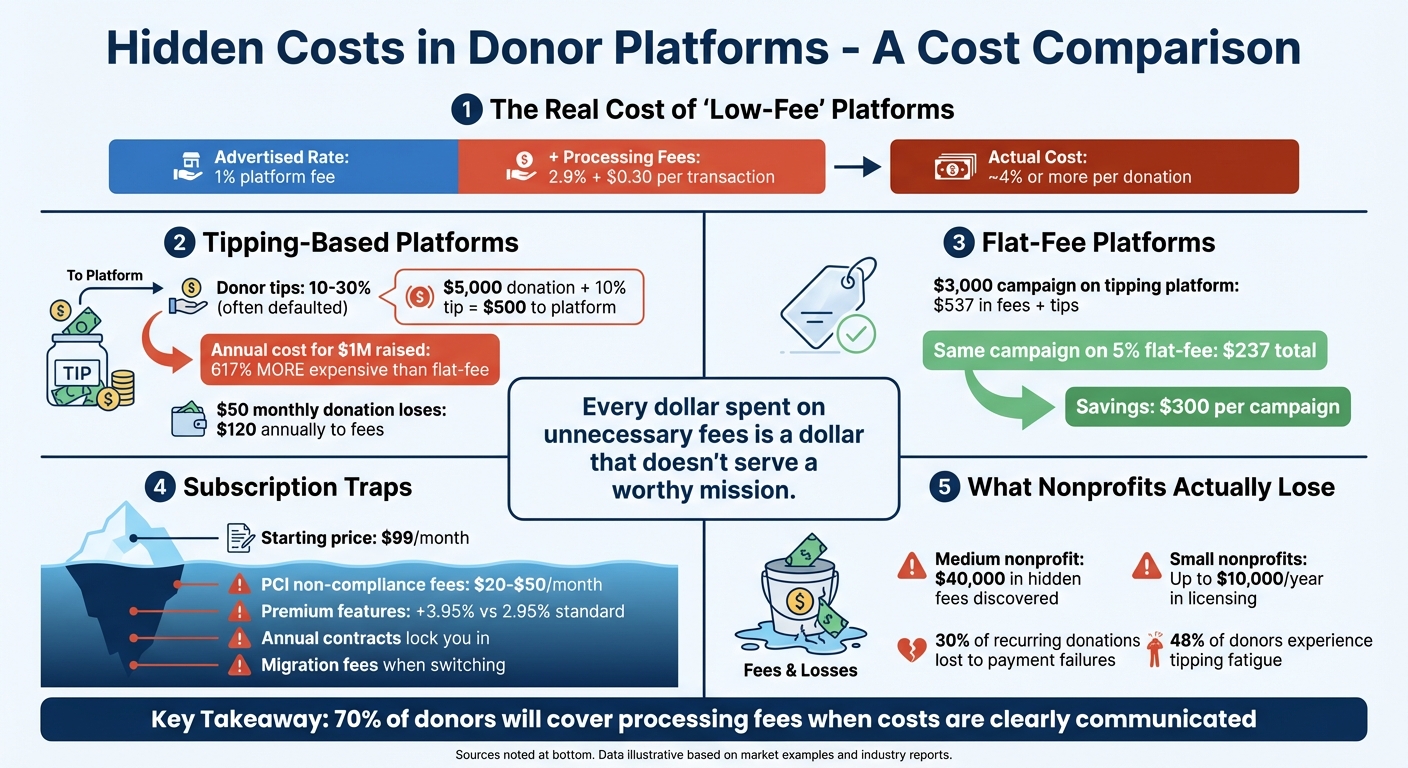
Hidden Costs Comparison: Tipping-Based vs Flat-Fee Donor Platforms
Transaction Fees and Donor Tipping Options
Donor platforms often promote themselves as low-cost solutions, but when you factor in all the charges, the real cost can be much higher. For instance, a platform might advertise a 1% service fee, but nonprofits typically face additional processing fees - such as 2.9% plus $0.30 per transaction. When combined, these fees can push the total cost to around 4% or more for every donation.
Some platforms that claim to be "free" depend on a tipping model to cover their expenses. These platforms encourage donors to add a tip, often between 10% and 20%, and sometimes even as high as 30%. However, these tips are not tax-deductible. For example, if someone donates $5,000 and includes a 10% tip, that’s an extra $500 going to the platform instead of the nonprofit.
"I thought the tip was going to the nonprofit and not the software, such confusing language!" – John B.
On top of these fees, there are often other processing-related charges, like American Express fees, chargeback costs, or fees for automatic credit card updater services, all of which add to the overall expense.
And the costs don’t stop with transaction fees - subscription-based pricing models bring their own challenges.
Subscription Plans and Growth-Based Pricing
Subscription fees can seem affordable at first glance, with some platforms starting as low as $99 per month. But as a nonprofit grows, these costs often increase, especially if the organization needs more features or services.
Annual contracts can also be a trap. If the platform no longer meets the nonprofit’s needs, being locked into a year-long agreement can leave the organization stuck with a system that no longer works for them. Lower-tier plans often come with restrictions, like limits on the number of campaigns or events allowed. Exceeding these limits can result in additional charges, and switching providers might require paying data migration fees.
Disabling donor tipping on so-called "free" platforms can also lead to unexpected costs. In such cases, nonprofits might face platform fees ranging from 1% to 5% per transaction, which can end up costing as much as 30% more than a standard monthly subscription. Add in PCI non-compliance fees - ranging from $20 to $50 per month - and these "affordable" platforms can quickly become anything but.
Premium Features and Extra Charges
Beyond the basic fees, many platforms charge extra for advanced features that nonprofits often need.
For example, entry-level plans frequently exclude tools like peer-to-peer fundraising, online auctions, or text-to-give capabilities. To access these features, nonprofits may need to upgrade to a premium plan that comes with higher transaction fees - sometimes as much as 3.95% instead of the standard 2.95%. Similarly, tools like CRM systems, email marketing, custom branding, or priority support are often only available with more expensive subscription tiers.
"The payment processing industry is very complicated, and unfortunately, it leads companies to use creative marketing techniques in order to make their pricing look as low as possible, even though it may not be when you total everything up." – Joseph Hur, Anedot
Using separate platforms for different needs - such as one for donations, another for events, and yet another for volunteer management - can also lead to hidden costs. Managing multiple subscriptions, dealing with manual data entry, and handling the security risks of juggling several logins can turn what seemed like an affordable solution into a fragmented and expensive system.
How Hidden Costs Affect Faith-Based Nonprofits
Lost Revenue and Budget Pressure
Hidden fees can quietly drain a nonprofit’s resources, creating significant financial strain. For example, a nonprofit raising $1 million annually might find that a tipping-based platform costs 617% more than a flat-fee alternative. Similarly, a $50 monthly donation could lose up to $120 annually to these fees. One medium-sized nonprofit discovered they were unknowingly spending nearly $40,000 on hidden software fees, while smaller organizations often face annual costs of up to $10,000 for software licensing across disconnected tools. These unplanned expenses don’t just stretch budgets - they also risk undermining donor confidence.
Damaged Donor Trust and Experience
Complicated fee structures can leave donors feeling frustrated and even betrayed. With 48% of people reporting fatigue from constant tipping requests, the act of giving can shift from fulfilling to frustrating.
"Tipping is a total rip-off. I don't make any of those donations anymore; I'll find a way to directly donate to the cause."
– Hannah S., Donor
This disillusionment grows when donors realize that part of their contribution - intended for the mission - is instead funneled to a software company via a "tip." For instance, one nonprofit representative shared how a $5,000 donation automatically prompted a 10% tip suggestion:
"The extra $500 would give pause to any donor, even one with a longstanding relationship with our organization."
– Joanna D., Nonprofit Representative
These moments of confusion and mistrust can severely impact the ability of faith-based nonprofits to fulfill their mission, adding layers of operational risk.
Disconnected Data and Workflow Problems
Beyond financial losses, hidden fees often lead to inefficiencies that ripple through an organization. Fragmented systems make it difficult to maintain a clear, unified view of donor interactions. For instance, donation data might live in one platform, event registrations in another, and volunteer information in yet another. This siloed approach can obscure critical insights and compromise the accuracy of donor records.
The impact doesn’t stop there. Nonprofits can lose up to 30% of recurring donations due to payment failures - problems that could be avoided with automated tools. Unfortunately, basic or so-called "free" platforms often lack these capabilities. Additionally, juggling multiple logins across platforms not only wastes time but also increases the risk of security breaches involving donor information. Hidden costs in these areas don’t just affect the bottom line - they also disrupt the workflows that keep nonprofits running smoothly.
sbb-itb-deea482
How to Find and Reduce Hidden Costs
Review Platform Contracts and Pricing Details
Start by requesting a detailed breakdown of fees from your platform. This should include everything - payment processing fees, platform fees, chargeback fees, and even charges for card updates.
Be cautious of dynamic pricing models that increase licensing fees as your organization grows. Some platforms might market themselves as "free" but only if donor tipping is enabled. If you disable this option, you could suddenly face platform fees ranging from 1% to 5% per transaction. Additionally, check whether live phone or chat support is part of your package or if you'll be billed at hourly rates once you exceed your allocated support time. Hidden charges can sneak in, like monthly fees of $20 to $50 for PCI non-compliance if your security documentation isn’t up to date.
To dig deeper, try simulating the donation process to reveal any other hidden costs.
Test the Donation Process for Hidden Charges
Conduct a test donation to experience the process as if you were a first-time donor. Have your team go through the entire journey and pay close attention to tipping prompts that may default to 12%–20% of the donation amount. Calculate your effective rate by dividing the total fees paid by the total donations raised - this will give you a clearer picture of the true percentage cost.
Scrutinize your monthly statements for unexpected charges like a "Card Update Fee" (around $1.00 per card), "Statement Fee", or any delays in payouts. Some platforms may take five or more business days to transfer funds, which could disrupt cash flow during crucial fundraising periods.
Once you’ve identified the immediate fees, shift your focus to how these costs might grow as your organization expands.
Calculate Future Costs Based on Growth
Understanding your current fees is only part of the equation - you also need to anticipate how these costs will scale. Project your expenses over the next 3 to 5 years based on expected donor and revenue growth. For instance, if you’re raising $500,000 today and aim to hit $1 million in three years, apply the platform’s full fee structure to your future revenue. Keep in mind that platform fees often fall between 2% and 10% per transaction. An 8% platform fee on $50,000 in donations, for example, would mean $4,000 less for your programs.
"When you're looking at your total cost to raise money, you should be sure to ask if the donation platform fee includes your payment processing." – Joseph Hur, Anedot
Also, inquire about additional costs for exceeding limits on campaigns, events, or donor records as your organization grows. Avoid signing multi-year exclusive contracts that could lock you into outdated technology, and don’t overlook staff costs for manual data entry, which can end up being as much as twice an employee's salary.
Solutions: Clear Pricing and Professional Guidance
Once nonprofits identify hidden fees, the next step is to explore transparent pricing models and expert support to better manage costs.
Flat-Fee Pricing and Open-Source Tools
Flat-fee pricing models simplify budgeting by replacing unpredictable percentage fees and donor tip-based systems with consistent monthly or annual charges. For example, on a tipping-based platform, a $3,000 fundraising campaign could result in donors paying an extra $537 in fees and tips. In contrast, a straightforward 5% fee model would only cost $237. This stark difference shows how tipping-based platforms can end up being 617% more expensive than flat-fee alternatives.
"The money going to these tip-based platforms could be going to your nonprofit. Those tips were generosity that already existed in your donor's budget… generosity intended to help a cause they care about." – Ronald Pruitt, President and Founder of 4aGoodCause
When choosing a platform, make sure that any optional donor tips go directly toward advancing your mission - not the platform's profits. For instance, CausePilot charges a 5% platform fee plus standard processing fees (2.9% + $0.30) without prompting donors for tips. Similarly, Donorbox offers a 2.95% platform fee for standard donations with no setup fees.
For nonprofits looking to implement these models seamlessly, working with professional partners can simplify the process and reduce costs.
Working with Share Services
Share Services provides a transparent, hands-on approach to managing platform fees. Their Strategy Retainer, priced at $3,500 per month, includes strategic guidance, project management, and clear KPI reporting - all without hidden costs. This pricing model directly addresses the unexpected fees nonprofits often encounter.
"Without a dedicated partnership, nonprofits miss crucial guidance, strategy development, and issue resolution." – GiveSmart
Share Services focuses on nonprofits with annual revenues between $1–$20 million, offering tailored fundraising strategies, donor retention plans, and new donor acquisition campaigns. Their Monthly Project Budget ($3,000/month) covers initiatives like donor programs, email marketing, branding, and content creation. Additionally, their Paid Media Spend ($1,500/month) helps expand reach through Meta ads, Google Ad Grants, and targeted donor acquisition efforts.
Donor Engagement Methods to Reduce Risk
Recurring giving programs offer a dependable way to protect against fluctuating platform fees. Monthly donors are five times more valuable over their lifetime and boast an impressive 83.6% retention rate. Nonprofits using advanced engagement strategies saw average increases of 53% in recurring revenue and 77% in overall online revenue in 2020.
Beyond providing stable income, creative engagement strategies can help offset transaction costs. For example, adopting a "donors cover fees" model allows supporters to absorb the 2.2%–3% processing fees, ensuring your nonprofit keeps the full donation amount. Use multi-channel outreach methods - like SMS campaigns, automated emails, and peer-to-peer fundraising - to broaden your reach and increase donor conversions. AI-driven insights can further enhance donor engagement by analyzing behavior and delivering personalized follow-ups that strengthen connections to your cause. Finally, reduce donation abandonment rates by offering seamless giving options, such as embeddable forms and digital wallets like Apple Pay and Venmo.
Conclusion
Hidden fees are more than just a financial inconvenience - they undermine donor trust and strain the resources nonprofits rely on to fulfill their missions. For faith-based organizations processing $1,000,000 in donations, these hidden charges can quietly drain hundreds of thousands of dollars over time. Beyond the monetary impact, unclear pricing models and frequent tipping prompts create a frustrating experience for donors, leading to fatigue and diminished confidence in the giving process.
"Hidden fees don't just cost you money; they impact donor trust, staff efficiency, and long-term sustainability." – CharityEngine
To tackle these challenges, nonprofits must take a proactive approach. This includes auditing platform contracts, evaluating the donation process, and calculating the true effective rate of all fees involved. By transitioning to platforms with transparent pricing - whether through flat fees or straightforward percentage-based models - organizations can achieve predictable budgets and foster stronger relationships with their donors. In fact, studies show that 70% of donors are willing to cover processing fees when these costs are clearly communicated. Transparency turns what could be a source of frustration into an opportunity for partnership.
For nonprofits navigating this transition, expert support can make all the difference. Share Services offers a transparent pricing model (with a $3,500/month Strategy Retainer and a $3,000/month Monthly Project Budget) designed to eliminate surprise fees and optimize donor engagement. Their programs help organizations with $1–$20 million in revenue implement strategies like recurring giving and multi-channel campaigns, ensuring that platform costs are offset while building stronger, lasting donor connections.
"Every dollar spent on unnecessary fees is a dollar that doesn't serve a worthy mission." – Nauras Abul Haija, Vardot
Choosing platforms and partners that prioritize transparency is key to achieving both financial stability and donor trust. By applying the strategies outlined here, nonprofits can ensure that every donation directly supports their mission, empowering them to focus on advancing the causes their supporters care about most.
FAQs
What hidden costs should nonprofits watch for in donor platforms?
Nonprofits using donor platforms often run into hidden expenses that can stretch their budgets. These typically include payment processing fees - usually around 2–3% of the donation, plus an additional $0.30 per transaction - and platform service fees, which might be disguised in “free” plans or charged per transaction. Some platforms tack on donor tip fees, ranging from 10–30% of the donation, along with extra charges for handling refunds, voided transactions, or recurring donations.
On top of that, nonprofits might need to pay for add-on features or software modules, like advanced reporting tools or integrations with other systems. To steer clear of unexpected costs, it’s essential to thoroughly review the platform’s pricing structure and terms. Solutions like ShareServices can help by offering clear pricing and support tailored specifically for nonprofits.
How can nonprofits avoid hidden costs when using donor platforms?
Hidden costs can sneak up on nonprofits using donor platforms, often exceeding the advertised price. These extra expenses might include software licensing fees, fragmented integrations requiring multiple subscriptions, transaction fees (like 2.2% + $0.30 per credit card transaction), or tip-based pricing models that shift costs onto donors. Even "free" platforms can come with a catch, often lacking critical support, leaving staff to handle technical issues on their own.
To sidestep these unexpected charges, nonprofits should take a closer look at contracts for a clear breakdown of all fees. Opting for platforms with flat-rate processing fees and consolidating tools to avoid redundancy can also help cut costs. Negotiating caps on transaction fees is another smart move. Plus, choosing a vendor with reliable support can save both time and money by reducing the need for extra troubleshooting.
Share Services offers a solution with transparent, flat-fee pricing and integrated tools, helping nonprofits streamline their operations, dodge hidden costs, and stay focused on their mission.
How can hidden fees on donor platforms affect donor trust and nonprofit finances?
Hidden fees - like undisclosed processing charges, misleading claims of "no-platform-fee", or vague donor-tipping options - can erode donor trust. When donors discover that a portion of their contribution is being redirected to cover platform expenses instead of reaching the cause they intended to support, they may feel deceived. This sense of betrayal can result in fewer donations, negative reactions, or even a loss of loyal supporters. The solution? Clear and honest communication about fees is essential for keeping donor confidence intact.
For nonprofits, these hidden costs also come at a price. They chip away at net revenue and add unnecessary complexity to administrative tasks. Every percentage deducted by a platform means fewer dollars available for vital programs, and unclear fee structures can make accounting and donor communication more challenging. Opting for a platform with upfront pricing and easy-to-understand reporting allows nonprofits to build trust with their supporters and dedicate more resources to their mission.
Related Blog Posts
Get helpful resources, straight to your inbox
We love sharing tools, ideas, and stories that make nonprofit work a little lighter and a lot more effective. Sign up below and we’ll send you practical tips, free resources, and a bit of encouragement—because the work you’re doing matters.
No spam. Just good stuff for good people.