
Jan 17, 2026
How Email Stories Drive Recurring Donations
Recurring donations are the backbone of nonprofit funding, and email storytelling is one of the most effective ways to encourage them. Here's why it works:
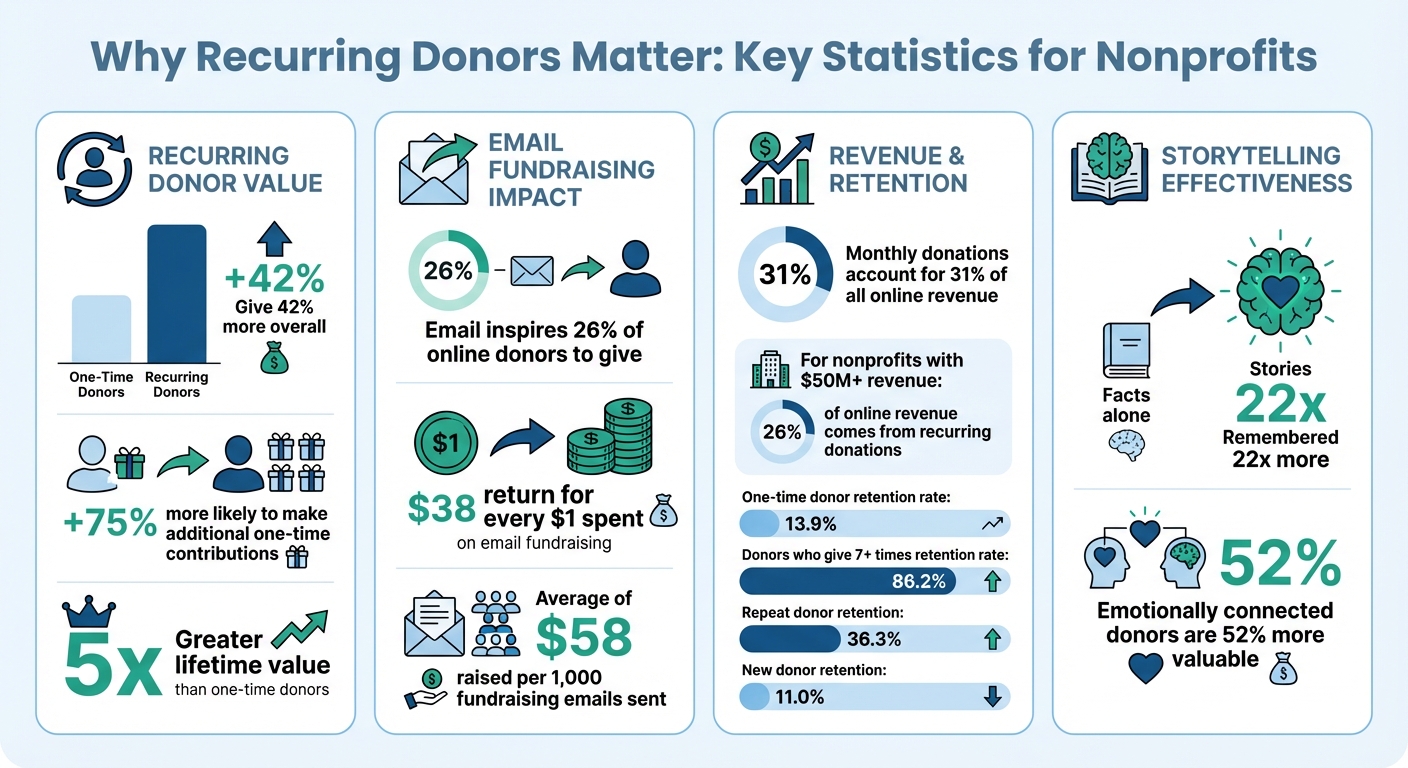
- Recurring donors give 42% more overall than one-time donors and are 75% more likely to make additional contributions.
- Email inspires 26% of online donors to give, making it a top-performing channel for fundraising.
- Monthly donations now account for 31% of all online revenue for nonprofits, with steady growth even when one-time giving stagnates.
The secret? Emotional storytelling. Stories connect donors to the cause, turning statistics into relatable, human experiences. Nonprofits that focus on individual narratives and show the donor's impact can increase retention and build long-term support.
This article explains how to craft email stories that move donors to act, from writing techniques to segmentation strategies, and how to extend those stories across platforms for maximum impact.
Recurring Donor Impact Statistics for Nonprofits
Why Recurring Donors Matter for Nonprofits
Financial Impact of Recurring Donations
Recurring donors bring a stronger and more consistent financial foundation to nonprofits compared to one-time contributors. These supporters not only represent a higher lifetime value but also give more over time. In fact, they contribute 42% more overall and are 75% more likely to make additional one-time gifts. For larger nonprofits with annual revenue exceeding $50 million, recurring donations account for 26% of all online revenue.
The frequency of donations also plays a significant role in donor retention. While one-time donors have a retention rate of just 13.9%, donors who give seven or more times boast an impressive 86.2% retention rate. Even early on, the difference is clear: repeat donors have a retention rate of 36.3%, compared to only 11.0% for new donors. These higher retention rates empower nonprofits to think beyond short-term goals and focus on sustainable, long-term strategies.
"Over the course of their involvement with your nonprofit, recurring monthly donors provide five times greater value than one-time donors, giving 42% more overall." - Korrin Bishop
How Predictable Revenue Improves Operations
Consistent monthly income transforms the way nonprofits function. Instead of constantly seeking new funding sources, organizations can budget responsibly and allocate resources effectively based on steady revenue streams. This stability allows nonprofits to plan ahead and invest in long-term programs rather than scrambling to address immediate financial gaps.
Take, for example, Milagro House during the challenges of 2020. Their recurring giving program became a lifeline, providing reliable funding to sustain critical programs throughout the pandemic. By illustrating how a $30 monthly gift adds up to $360 annually, they encouraged donors to see the tangible impact of their support, creating a sustainable model that weathered economic uncertainty. Similarly, the Turner Syndrome Society of the United States grew its recurring donor base from just 11 supporters to over 500 by implementing a structured monthly giving program, showcasing how predictable revenue can drive growth.
"Sustainability isn't just a buzzword; it's the lifeblood of any nonprofit. Recurring donations provide that very cushion." - Jeremy Reis
This dependable source of income not only stabilizes daily operations but also fosters stronger, more meaningful connections with donors, helping nonprofits build lasting relationships.
sbb-itb-deea482
Storytelling for Nonprofits: Streamlined templated process
How Stories Create Emotional Connections
For nonprofits aiming to secure recurring donations, the secret lies in forming emotional bonds with donors - and storytelling is the most powerful way to do it.
How Stories Spark Empathy and Action
When we hear a story, our brains light up in areas tied to empathy and memory, making the message stick and driving us to act. This is why storytelling often beats cold, hard statistics when it comes to fundraising.
Deborah Small, a marketing professor at Wharton, discovered something fascinating: statistics can actually dampen generosity. Why? Numbers push people into a "calculative" mode, which dulls their emotional response. Her research highlights how data-heavy appeals can unintentionally reduce the urge to give.
"The more vivid the story – through narrative or through imagery – the more emotionally arousing. And emotions are what triggers the impetus to help. The more surprising finding is that showing statistics can actually blunt this emotional response by causing people to think in a more calculative, albeit uncaring, manner." - Deborah Small, Marketing Professor, Wharton
Stories that focus on sudden, dramatic events - like a family losing their home - tend to evoke stronger sympathy than those describing ongoing hardship. This technique, called "loss framing", helps donors imagine themselves in the same situation, deepening their emotional connection.
The most effective recurring giving campaigns often use the hero framework. In this setup, the person in need becomes the hero battling a challenge (the villain), and the donor steps in as the rescuer. This approach gives donors a sense of purpose and personal involvement, making them more likely to stick with monthly contributions.
By combining emotional triggers with personal narratives, nonprofits can create stories that resonate deeply - far more than numbers ever could.
Why Personal Stories Work Better Than Numbers
When it comes to inspiring donors, individual stories win every time. This is thanks to the identifiable victim effect, which shows that people are more likely to give when they can connect with a single person rather than a sea of statistics. In fact, research reveals that stories are remembered up to 22 times more than facts or figures alone.
Focusing on one protagonist is key. Highlighting a single face and name fosters connection, while showcasing large groups or multiple beneficiaries can actually overwhelm or desensitize donors. As Justin Wheeler, CEO of Funraise, puts it: "Donors don't just fund causes - they fund transformations they can see".
While data plays an important role in building trust, it works best after an emotional story has already captured the donor's attention. For example, start with a moving narrative, then follow up with numbers that show the tangible impact - like explaining how a $30 monthly gift adds up to $360 a year.
Finally, make the donor the star of the story. Using "you" language, such as "Your monthly gift of $50 helped Sarah return to school", positions the donor as the hero. This approach not only boosts engagement but also encourages long-term support.
Writing Effective Email Stories
Crafting an email that resonates and drives action isn't just about words - it's about telling a story that connects emotionally. Here's how to create compelling email stories that encourage recurring donations.
Core Components of a Strong Story
A good email story revolves around three key elements: a relatable person, a clear problem, and a solution that highlights the donor's role. Keep the focus on a single individual to make the narrative personal and impactful. For example, you might write, "Your monthly gift of $30 helped Paul get three meals a week." Using "you" throughout the email makes the donor feel like the hero of the story.
Creating a sense of community around your recurring donation program can also boost engagement. For instance, Many Hopes named their monthly giving program "The Family", fostering a sense of belonging and increasing donations. Similarly, Operation Broken Silence calls their donor circle "The Renewal", offering perks like membership pins and free event tickets for those contributing $35 or more per month.
Showing Donor Impact Clearly
People want to know how their contributions make a difference. Use impact blocks to break down monthly donations into tangible outcomes. For example, Milagro House shows that a $30 monthly gift adds up to $360 annually, making the impact feel real and measurable.
Including direct quotes from beneficiaries adds authenticity and builds trust. These quotes provide a behind-the-scenes look at how donations are used. Between 2020 and 2022, Variety BC raised $1 million in just 15 months by sharing stories of children and families who benefited from their programs, showcasing the ripple effect of donor support.
To make donation requests relatable, frame them in terms of everyday trade-offs. Instead of simply asking for $20 per month, you could say, "Skip one Friday happy hour to give $20/month." This helps donors visualize the commitment in a more approachable way.
Email Format and Structure for Better Results
Once your story is ready, presenting it in the right format is crucial. Keep emails concise: aim for 300–500 words for shorter messages, 500–750 words for full stories, and about 250 words if you're linking to a landing page. With the average person spending less than 10 seconds on an email, brevity is key.
Structure your email for easy reading. Use short paragraphs (three lines or fewer) and include a mid-email image that links directly to your donation page. Since many readers instinctively click on visuals, always hyperlink images to your donation form.
Subject lines should be under 50 characters to ensure they display fully on mobile devices, where most emails are opened. Timing also matters - emails sent between Tuesday and Thursday, ideally between 10:00 AM and 2:00 PM in the recipient's time zone, tend to perform best.
For a clean and focused email, link exclusively to your donation form. Avoid including multiple links, which can distract readers. Place your call-to-action (CTA) prominently, above the fold, where it’s immediately visible. Buttons should be at least 44x44 pixels to make them easy to tap on mobile devices.
In 2024, nonprofits raised an average of $58 for every 1,000 fundraising emails sent. Additionally, 26% of online donors reported that email was the most inspiring tool for motivating them to give. Make every email count by combining strong storytelling with a clear, actionable format.
Segmentation and Personalization Strategies
Once you've mastered the art of engaging email storytelling, the next step is ensuring those stories reach the right people. That's where segmentation and personalization come in. These strategies ensure your message resonates with donors on a personal level. Let’s face it - generic emails rarely inspire recurring gifts. But when your message speaks directly to a donor’s interests and giving history, it’s a whole different ballgame. By dividing your donor list into specific groups, you can craft tailored stories that truly connect.
Grouping Donors by History and Interests
To start, organize your email list based on donation history. Think of categories like first-time donors, repeat donors, major donors, and lapsed donors. Each group has unique needs. For instance, a first-time donor might appreciate a warm welcome paired with an immediate impact story, while a lapsed donor might respond better to a heartfelt reminder of the difference their past support made.
You can take it a step further by segmenting donors based on their interests. Let’s say you run an animal shelter. If a donor has shown interest in supporting dogs, they’re far more likely to engage with a story about a rescued dog than one about wildlife. Here’s a real-world example: In September 2016, GlobalGiving used a recommendation engine to analyze donor habits and preferences. By suggesting a women’s empowerment project in Uganda to someone who had previously supported a similar project in Kenya, they saw a 10x increase in donations and engagement compared to their generic newsletters. In fact, aligning outreach with giving history can boost engagement by 20%.
You can also segment by donor engagement levels. For example, track metrics like email clicks and target "clicker-non-donors" with follow-up emails that acknowledge their interest and encourage further involvement.
And personalization doesn’t stop at using a donor’s first name. Reference specific milestones or highlight local impact to make them feel truly valued. Once you’ve clearly defined your donor segments, you can create structured email sequences that nurture these relationships into recurring support.
Building Email Sequences for Recurring Giving
Tailored email sequences are a powerful way to turn one-time donors into regular supporters. Automated sequences can guide donors through a journey - from their first gift to becoming monthly contributors. A proven five-step sequence includes: an immediate thank-you, a compelling mission story, a clear explanation of monthly giving benefits, donor testimonials, and finally, a direct ask.
Timing plays a key role here. While traditional wisdom once suggested waiting six months before asking for a second gift, research now shows that many donors are open to giving again within 45 days of their initial donation. For example, during charity: water’s 2012 campaign for the Rulindo District in Rwanda, they used a thoughtful email strategy. Highly engaged supporters received a pre-launch email, followed by weekly updates packed with videos and stories - without direct donation asks. The result? A 21% increase in open rates, with 58% of fundraisers actively raising donations (up from 50%). The campaign exceeded its $1.7 million goal, raising over $2 million.
"We chose to share videos and stories rather than make fundraising or donation asks because we believe in sending what is best for our subscribers, rather than what is best for us."
– Sarah Salisbury, Digital Marketing Manager, charity: water
Your email sequences should align with the donor lifecycle. For new donors, create a welcome journey that emphasizes belonging and immediate impact. One-time donors can be nurtured into recurring supporters with storytelling and follow-ups. Lapsed donors may respond to messages that reference their past giving, while regular monthly donors should receive consistent updates showcasing the ongoing impact of their contributions.
A stewardship series is particularly effective after any gift. Start with an immediate thank-you, follow up within a week with an impact report showing what their donation accomplished, and provide long-term milestone updates to keep them engaged. This approach not only builds trust but also keeps donors primed for future contributions.
Extending Stories Across Multiple Channels
Once you've crafted compelling stories for email, take them further by sharing them across multiple platforms to maximize their reach. Email is just one piece of a larger puzzle. The stories that resonate in your inbox can thrive on social media, video platforms, and more. When you adapt and repurpose these narratives, you create a "surround-sound" effect that keeps your mission top of mind for your audience. The trick is to tailor your content for each platform while avoiding direct repetition. By syncing your efforts across channels with your email strategy, you strengthen the emotional bond that turns occasional donors into regular supporters.
Repurposing Stories for Different Platforms
One of the easiest ways to extend your email stories is to reimagine them for social media. Break longer stories into bite-sized pieces to sustain interest over time. For instance, if your email highlights a beneficiary’s journey from hardship to triumph, you could share the beginning of their story on Facebook, the turning point on Instagram, and the resolution on Twitter. Each post keeps the audience engaged while prolonging the story's impact.
Visual consistency is just as important. Use the same images across emails, landing pages, and social media to create a cohesive campaign that’s instantly recognizable. A great example comes from DIGDEEP, which shifted its storytelling in March 2020 to focus on frontline workers without clean water. By aligning its messaging with the pandemic's "wash your hands" mantra across emails, social media, and its website, the organization nearly doubled its World Water Day donations to $130,044 compared to 2019. By 2022, they raised $165,223.92 through a matching campaign with consistent messaging across all platforms.
You can also transform your mission’s impact data into engaging visuals like infographics or short videos for social media. Videos under 60 seconds tend to perform especially well. For example, TikTok saw nonprofits grow their follower counts by 37% in 2024, making it a rapidly growing platform for engagement. Additionally, 50% of nonprofits partnered with social media influencers in 2024, with 60% of those collaborations focused specifically on fundraising.
"Repurposing content is the key to a thorough, engaging communications strategy."
– Mike Montalto, Amplify NP
By repurposing your stories and ensuring consistent updates, you can build trust and deepen connections with your audience.
Keeping Donors Engaged with Regular Updates
Extending your story is only half the equation - keeping donors engaged is just as crucial. Recurring donors need consistent communication to stay invested. Frequent updates, like impact reports and thank-you messages, help build long-term relationships. For example, in 2021, Girls Who Code created an interactive digital Impact Report on their website. It combined personal stories with clear metrics, allowing donors to see exactly how their contributions made a difference. This transparency strengthened trust and encouraged continued support.
A stewardship series can make a big difference in donor retention. Start by thanking recurring donors immediately after their contribution, follow up within a week with an update on their impact, and send milestone reports to keep them engaged over the long term. Share these updates not only through email but also on your website and social channels. Showing donors how their gifts are being put to use reinforces their commitment to your cause. Studies show that emotionally connected donors are 52% more valuable to organizations than those who aren’t.
Conclusion
Email storytelling is a powerful tool for creating recurring giving programs that thrive. By crafting narratives that evoke empathy, position donors as heroes, and highlight clear results, you can transform one-time contributors into loyal monthly supporters. The numbers back this up: recurring donors offer higher long-term value, and email fundraising boasts an impressive return of about $38 for every $1 spent. The potential here is undeniable.
To make it work, consistency is key. Personalized email campaigns, donor-focused stories, and regular impact updates help nurture the emotional bonds that keep donors engaged. This approach should extend beyond emails to include updates across multiple platforms, ensuring your mission stays front and center. As Justin Wheeler, CEO of Funraise, wisely notes: "Donors don't just fund causes - they fund transformations they can see". When you show donors the real-world change their monthly gifts create, you give them a compelling reason to stay committed.
Ready to get started? Start small: segment your donor list, craft a single impactful story about a beneficiary, and launch a stewardship series that immediately thanks donors and showcases their impact. Use the SUCCESs model to guide your storytelling - make it Simple, Unexpected, Concrete, Credible, Emotional, and Story-driven. Then, amplify those messages across your website and social media to create a unified narrative that reinforces your mission.
Here's a stat to keep in mind: 26% of online donors say email is the communication channel that most inspires them to give. That means your stories have the power to turn casual supporters into lifelong advocates. By focusing on emotional storytelling, thoughtful segmentation, and consistent engagement across platforms, you can build a recurring giving program that not only provides stable revenue but also strengthens your nonprofit’s connection with its community.
Your stories have the potential to create lifelong supporters. Make them count.
FAQs
How does emotional storytelling help nonprofits retain donors?
Emotional storytelling has a unique ability to connect donors to your mission on a deeply personal level. When nonprofits share vivid, donor-focused stories that showcase the tangible impact of contributions, they create a sense of purpose and belonging for their supporters. This emotional bond not only inspires generosity but also encourages donors to stay engaged and give more consistently.
Here’s a key insight: recurring donors who receive story-driven updates tend to give 42% more over time compared to one-time donors. Even more impressive, they’re 75% more likely to contribute additional gifts. By crafting narrative-rich emails that highlight real-life impact, nonprofits can keep donors emotionally invested, reduce drop-off rates, and transform occasional contributors into loyal, long-term supporters.
This is where Share Services steps in. They specialize in helping nonprofits design and automate email campaigns that combine the art of storytelling with data-backed strategies. Their approach ensures your messages not only inspire action but also nurture lasting relationships with your donors.
How can I create email stories that inspire recurring donations?
To create email stories that inspire recurring donations, focus on a single, powerful narrative that demonstrates the real-world impact of monthly contributions. For instance, you might say, "With just $25 a month, you can provide clean water for 10 children every week." Use donor-focused language by speaking directly to the reader and emphasizing their role as the hero in the story. Add vivid details and include a strong visual element, like a photo or video, to make the story more personal and compelling. Wrap it up with a clear call-to-action that encourages the reader to begin or continue their monthly giving.
Personalization plays a big role here. Segment your email list so recipients receive stories that align with their past donations or interests. Using dynamic fields like their first name or crafting tailored subject lines can significantly boost engagement. Make sure your emails are mobile-friendly so they look great on any device. To reinforce trust, pair your story with impact data and testimonials from those who have benefited. By combining these elements, you can turn one-time donors into dedicated, long-term supporters.
How can nonprofits use email segmentation and personalization to boost recurring donations?
Nonprofits can make the most of segmentation by organizing donors into groups based on factors like how often they give (one-time versus recurring), donation size, specific program interests, geographic location, or recent interactions (like attending an event or opening an email). With these tailored groups, you can craft messages that align with what motivates each donor. For instance, a new donor might receive a warm welcome email featuring a success story, while a lapsed donor could get a personal note acknowledging their past contributions and inviting them to reconnect.
Personalization goes even further by weaving in donor-specific details, such as their name, previous donations, or the tangible impact of their support. Dynamic content can adapt stories, data, or calls-to-action to match the recipient’s interests. Personalized subject lines and messages make emails feel less like a mass appeal and more like a genuine conversation, boosting engagement and encouraging donors to give again. When nonprofits combine segmentation with personalization, they create deeper connections with their supporters and build a foundation for sustained giving.
Related Blog Posts
Get helpful resources, straight to your inbox
We love sharing tools, ideas, and stories that make nonprofit work a little lighter and a lot more effective. Sign up below and we’ll send you practical tips, free resources, and a bit of encouragement—because the work you’re doing matters.
No spam. Just good stuff for good people.