
Feb 17, 2026
State Compliance for Online Fundraising
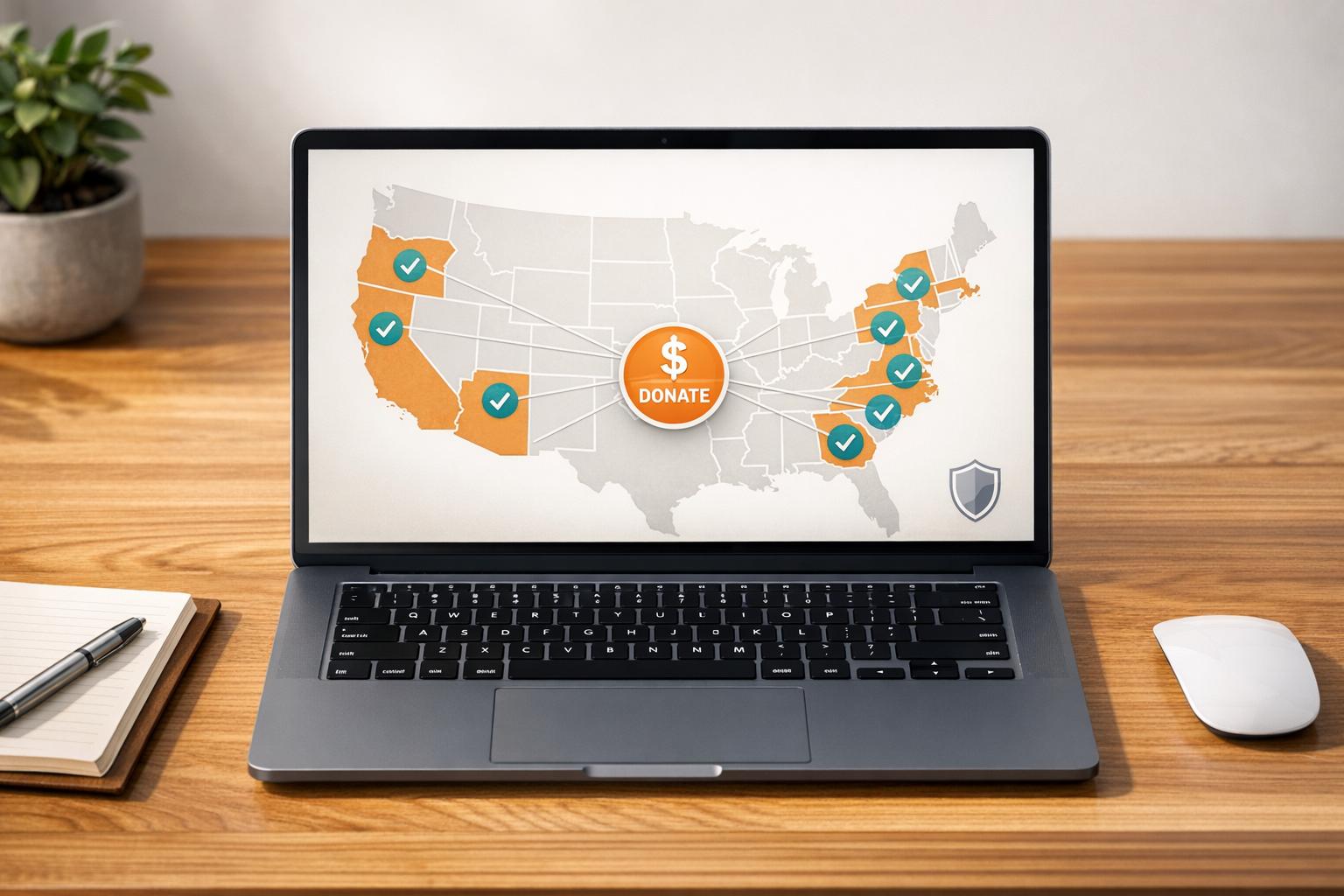
Nonprofits fundraising online face strict state compliance rules. 40 states require registration before soliciting donations, even if your organization doesn't have a physical presence there. A simple "Donate Now" button on your website can trigger these requirements. Noncompliance risks include fines, platform bans (e.g., Facebook, PayPal), and loss of donor trust.
Key points:
- Registration is mandatory in most states before asking for donations.
- Thresholds vary: Some states require registration for even $1; others, like New York, set it at $25,000.
- Disclosure rules: 24 states require specific language on fundraising materials.
- Noncompliance penalties: Fines, bans from fundraising platforms, and potential legal action.
- Strategies for compliance: Register nationwide, focus on high-donor states, or use disclaimers to limit fundraising scope.
Compliance ensures legal fundraising, protects donor trust, and avoids operational disruptions. Once compliant, you can focus on building relationships through a donor welcome series to retain new supporters. Use tools or services to manage registrations, deadlines, and evolving state laws effectively.

State Compliance Requirements for Nonprofit Online Fundraising
State Compliance Basics for Online Fundraising
What is Charitable Solicitation?
Charitable solicitation refers to any request for something of value intended for a charitable purpose. Labyrinth Inc. explains it simply:
Generally speaking, [charitable solicitation] is the simple act of asking for something of value. It can take many forms. Examples include events, direct mail, phone calls, emails, and broadcast ads.
When it comes to online fundraising, this definition broadens significantly. A "Donate Now" button on your website, email campaigns asking for contributions, or even social media posts seeking support all fall under the umbrella of active solicitations. Even follow-up communications can trigger state registration requirements.
Here’s the tricky part: because websites are accessible nationwide, regulators often treat online fundraising as a form of solicitation across all states. This means you don’t need a physical presence in a state to be subject to its registration rules. As attorneys from Venable LLP explain:
Solicitation is usually defined to include oral, written, or online requests for contributions, meaning that the organization does not have to be physically present in the state to engage in potentially registrable solicitation activities.
The Charleston Principles offer some clarity, suggesting that registration is necessary if your organization specifically targets residents of a state or receives frequent or substantial donations from that state. However, these principles are non-binding and not universally followed, leaving nonprofits to navigate state-specific rules on their own.
State Regulations for Nonprofits
State regulations around solicitation add another layer of complexity, with varying thresholds and disclosure requirements. For instance, California requires registration if your organization raises even $1 from its residents, while New York sets the threshold at $25,000. Around 15 states offer exemptions for smaller nonprofits that raise less than $25,000 annually, provided they don’t use professional fundraisers. On the other hand, 10 states - such as Arizona, Delaware, Idaho, and Vermont - don’t require any charitable solicitation registration at all.
But registration isn’t the only requirement. In 25 states, nonprofits must include specific disclosure statements on all written solicitation materials, including websites. For organizations operating online, this means juggling compliance requirements in over 40 different jurisdictions at once.
How Outdated Laws Affect Digital Fundraising
As online fundraising becomes more common, many state laws still reflect outdated, pre-internet fundraising models. These statutes were originally designed for traditional methods like direct mail, phone calls, and in-person events. They don’t account for the realities of a single website reaching donors across the entire country.
Greg McRay, CEO of The Foundation Group, highlights the issue:
Most states consider virtually any form of revenue generation by a 501(c) nonprofit to be a form of solicitation.
This means that in 19 jurisdictions, even having a simple "Donate" button on your website can require mandatory registration. Meanwhile, other states view the same button as passive and don’t impose the same requirements.
Harbor Compliance points out that many state laws lack clear guidance for online fundraising because they were written before the internet became central to nonprofit operations. The Charleston Principles, introduced in 2001 to create a standardized approach:
have never been ratified into law
and are only formally recognized by about 17 states. This patchwork of rules leaves nonprofits in a tough spot, where something as simple as sending an automated thank-you email or an electronic newsletter can trigger registration requirements in states they didn’t intend to target.
sbb-itb-deea482
Registration and Disclosure Requirements
When Registration is Required
Nonprofits need to register before they start soliciting donations, not just when they receive them. This can get tricky because each state sets its own rules. Right now, 40 jurisdictions require nonprofits to register before asking their residents for donations. And since a "Donate Now" button on your website is accessible nationwide, it’s usually considered a solicitation in all these states.
The thresholds for registration vary widely. For instance, California requires registration for any amount of donations, even $1. New York, on the other hand, sets the bar at $25,000. Pennsylvania exempts organizations with contributions under $25,000, as long as they don’t use professional solicitors. In total, about 15 states offer similar exemptions for nonprofits with annual contributions under $25,000.
Once registration is sorted, the next step is understanding the specific disclosure requirements for fundraising campaigns.
Disclosure Requirements for Fundraising Campaigns
In addition to registration, 24 jurisdictions require nonprofits to include specific disclosure language in their written solicitation materials, including websites. These disclosures generally inform donors where they can find additional information about the nonprofit - either through a government agency or directly from the organization itself.
Out of these jurisdictions, 22 states require both registration and disclosure statements, while 2 states only mandate disclosure statements. To stay compliant, make sure your materials follow the exact language requirements for each state.
Registration Exemptions and Exceptions
Not every nonprofit has to register everywhere. Some states offer exemptions for specific types of organizations. For example, nine states don’t require charitable registration or disclosure statements at all. Other states provide exemptions for certain nonprofit categories, such as religious, educational, healthcare, or membership organizations. However, these exemptions aren’t automatic - you often need to file paperwork to confirm your status.
Take Massachusetts as an example: nonprofits with 10 or fewer contributors in a year are exempt, but they still need to verify this annually. Many exemptions also require yearly renewal, so it’s not a one-and-done process.
As the National Council of Nonprofits puts it:
Following the requirements of state laws is a basic tenet of ethical fundraising.
So, don’t assume your nonprofit is exempt. Always double-check the specific requirements for each state to avoid compliance issues.
Consequences of Noncompliance
Legal and Financial Penalties
Ignoring state fundraising regulations can have serious repercussions for your nonprofit. Financial penalties alone can climb beyond $5,000 for a single violation in one state, and missing renewal deadlines often leads to additional late fees that quickly add up.
On top of that, states may take civil or even criminal action against your organization. Leadership could face personal liability, with penalties ranging from fines and revoked solicitation privileges to, in extreme cases, the loss of tax-exempt status.
"The cost of fundraising registration is easily outweighed by state and federal penalties for noncompliance."
- James Gilmer, Compliance Specialist at Harbor Compliance
But the risks don’t end there - noncompliance can also erode public trust in your organization.
How Noncompliance Affects Donor Trust
When your nonprofit fails to comply with regulations, it damages your reputation. Public databases and charity rating platforms make compliance issues visible to anyone researching your organization. If potential donors discover you're not in good standing, their trust falters - and their donations may follow.
California's AB 488 law highlights this issue further. It requires online fundraising platforms like Facebook and PayPal to block nonprofits that aren't in "good standing" with state and federal agencies. Addressing such problems often pulls attention and resources away from mission-critical work, disrupting your operations.
"Noncompliance with solicitation laws can pose a grave threat to the sustainability and trustworthiness of a nonprofit organization."
Ultimately, compliance is about more than avoiding legal and financial consequences. It’s about safeguarding the trust that fuels your fundraising efforts. Recognizing these risks emphasizes why having solid compliance strategies in place is crucial.
Give Smart: Nonprofit Fundraising Compliance Essentials | Episode 6 w/ Ron Barrett of Cogency Global
How to Achieve State Compliance
Given the legal and financial risks nonprofits face, having the right compliance strategy is crucial. Here are three practical ways to maintain state compliance effectively.
Nationwide Registration Approach
Registering in all 40 states that require it allows your nonprofit to fundraise freely without worrying about restrictions. While this approach involves approximately $3,000 in filing fees, it eliminates the risk of accidental solicitation in unregistered states. This is especially beneficial for larger organizations with national reach or those planning extensive online fundraising campaigns.
"Compliance can and should be a badge of honor. The requirements, while complex, present an opportunity for organizations to demonstrate how serious they are about protecting their donors."
- Labyrinth Inc
Nationwide registration simplifies your operations. You won’t need disclaimers, donation-blocking tools, or constant monitoring of donation origins. It also strengthens donor trust by showing your commitment to regulatory standards. For nonprofits aiming to expand nationally, this approach provides peace of mind and reinforces transparency. However, if this option isn’t feasible, focusing on key states can be a practical alternative.
Targeted State Registration Approach
For organizations with limited resources, focusing on high-impact states is a smart move. Half of the U.S. population lives in just 10 states: California, New York, Florida, Illinois, Pennsylvania, Ohio, Michigan, Georgia, North Carolina, and New Jersey. Registering in these states, along with your home state, ensures you’re covering a significant donor base while keeping costs manageable.
Start by analyzing your donor data. Identify where your contributions are coming from and prioritize those states. Legal expert Stephen Fishman, J.D., provides helpful advice:
"Unless you receive at least $250 in donations each year from a state's residents, it makes no sense to register there because the cost of registration will exceed the value of the donations".
With state filing fees ranging from $10 to over $400, this threshold ensures you don’t spend more on compliance than you raise. This targeted approach balances compliance with cost-effectiveness and maintains donor trust. For nonprofits with hyper-local missions, there’s another strategy to consider.
Using Disclaimers to Limit Fundraising Scope
For smaller nonprofits with local goals, disclaimers offer a way to manage compliance obligations. By clearly stating on your donation pages which states you’re registered in and that you only accept donations from those residents, you can legally limit your solicitation scope. Pairing this with donation-blocking software ensures transactions from unregistered states are automatically declined.
To make this strategy work, consistency is key. Monitor your donation pages, email campaigns, and any other materials to ensure the disclaimer is always visible. While this method reduces compliance requirements, it also restricts your fundraising potential by excluding donors from states where you’re not registered.
Managing Multi-State Compliance
Once you've chosen a compliance strategy, the next step is managing the specific rules and deadlines for each state. With no single federal standard for charitable registration, you’ll need to navigate the unique regulations, forms, fees, and deadlines of the roughly 40 states that require registration. Below are some practical tools and techniques to help simplify multi-state compliance.
Centralized Compliance Management Tools
Managing multi-state filings in-house can be overwhelming. The process of juggling renewal dates, tracking regulatory changes, and preparing state-specific applications can place a heavy burden on your staff. This is where professional compliance platforms, like Affinity Single Portal®, come in. These tools can help generate applications, produce real-time status updates, and manage renewals - cutting administrative workloads by up to 99%.
"Professional service providers can manage renewals, annual filings, and any required updates to registration information, alleviating a significant administrative burden from the nonprofits."
- Greg McRay, Founder and CEO, Foundation Group
Outsourcing compliance tasks to experts reduces the risk of missed deadlines and legal penalties, while allowing your team to focus on your organization’s mission. Even for smaller nonprofits, basic compliance software can be a lifesaver, offering a centralized hub for essential documents needed for state filings. The next step is ensuring your records are accurate and well-organized.
Keeping Accurate Records
Keeping detailed records not only simplifies compliance but also protects your organization during audits. Maintain a digital archive of key documents such as registration confirmations, renewal receipts, and state correspondence. Tracking donation sources is equally important, as it helps identify when you meet state-specific thresholds that require action.
Renewal deadlines vary by state and are often tied to your fiscal year-end - commonly 4 months and 15 days after it closes. To stay on top of these deadlines, create a compliance calendar that accounts for these variations. If your Form 990 or financial audit isn’t ready in time for a state’s renewal deadline, you can usually file for an extension using IRS Form 8868 to maintain good standing.
Monitoring Regulatory Changes
State regulations are constantly evolving. As Greg McRay explains, "The rules and regulations from state to state are not only complex but constantly evolving". For example, states are increasingly scrutinizing digital fundraising tactics, treating "Donate Now" buttons and social media appeals as active forms of solicitation. Additionally, many states now mandate online filing systems, making the once-standard Unified Registration Statement (URS) largely obsolete.
To keep up, subscribe to updates from state attorney general offices and charity regulators in the states where you’re registered. Many professional compliance services also include monitoring as part of their offerings. Regularly review donation data to ensure you haven’t crossed any new thresholds that require additional registration. Staying proactive is key to avoiding compliance headaches.
How Share Services Supports Compliance and Fundraising
Navigating nonprofit fundraising while staying compliant with state regulations can feel like a balancing act. Share Services steps in to simplify this process for nonprofits with annual revenues between $1 million and $20 million. They focus on expanding digital fundraising efforts while ensuring everything aligns with compliance requirements. Their approach combines donor acquisition, retention strategies, and digital marketing expertise to support sustainable growth across multiple states.
While Share Services doesn’t directly manage compliance filings, their digital fundraising and marketing solutions provide the tools and insights you need to make smart decisions about expanding your fundraising reach. They fine-tune campaigns to align donor data with state registration requirements, helping nonprofits avoid the pitfalls of under- or over-registering in key states. This alignment between fundraising strategies and compliance needs ensures nonprofits can focus on growth without unnecessary legal or financial risks.
Flexible Services to Match Your Needs
Share Services offers several tailored solutions to help nonprofits grow their fundraising efforts while staying compliant:
- Strategy Retainer ($3,500/month): This service connects you with nonprofit strategists who help align your fundraising expansion plans with compliance requirements. Whether you're considering nationwide registration or focusing on specific states, this data-driven approach reduces the risks of under-registering while avoiding unnecessary costs from over-registering in low-donor areas.
- Paid Media Spend ($1,500/month minimum): Perfect for nonprofits running geo-targeted campaigns, this service leverages tools like Meta ads, Google Ad Grant campaigns, and OTT advertising to test donor response in specific states. Analytics track where donations are coming from, making it easier to decide when to register in a new state.
- Monthly Project Budget ($3,000/month): This option covers email marketing, branding, and content creation to ensure every registered state delivers maximum impact. After compliance is secured, Share Services focuses on cultivating donor relationships through multi-channel campaigns, optimized donation pages, and messaging designed to foster long-term loyalty.
Conclusion
State compliance isn't just a box to check - it’s the backbone of donor confidence and organizational stability. With 40 jurisdictions requiring registration and 24 to 25 states enforcing disclosure rules, nonprofits must navigate a maze of regulations. As Greg McRay, CEO of Foundation Group, explains:
Understanding whether your organization needs to register in multiple states... is not only essential for legal compliance but also for maintaining donor trust and organizational reputation.
The risks of noncompliance go far beyond fines. Organizations that fail to meet these requirements may find themselves barred from major online fundraising platforms like Facebook and PayPal Giving Fund. Additionally, donors increasingly rely on state databases and charity rating sites to verify an organization’s credibility. Being unregistered can unintentionally send a negative signal, potentially deterring support.
Taking a proactive approach to compliance not only minimizes legal exposure but also strengthens your organization’s reputation. As Labyrinth Inc highlights:
Compliance can and should be a badge of honor. The requirements, while complex, present an opportunity for organizations to demonstrate how serious they are about protecting their donors.
To stay compliant, nonprofits should register in their state of incorporation, as well as any state where they maintain a physical presence or receive significant donations. Include the necessary disclosure language on all digital materials, and monitor donation sources regularly to determine when new registrations are required. Using centralized tools and keeping meticulous records can help organizations manage multi-state compliance effectively, ensuring they meet renewal deadlines and adapt to regulatory changes.
FAQs
Does my website’s “Donate” button count as fundraising in every state?
Yes, having a “Donate” button on your website is typically viewed as a form of solicitation and could mean you need to register in every state where it's accessible. Many states consider online solicitation enough to trigger registration requirements, depending on their specific charitable solicitation laws and thresholds. Nonprofits should thoroughly review state regulations to make sure they’re meeting these requirements.
How do I know which states I must register in based on my donor data?
To figure out where your nonprofit needs to register, think about whether you're actively asking for donations in certain states. Most states require registration if you’re reaching out to their residents through methods like mail campaigns, online fundraising platforms, or targeted social media ads. Keep in mind that many states have broad definitions of solicitation, often including online activities. It’s important to check each state’s specific rules and thresholds, especially if your donor data shows you’ve been engaging with their residents.
What’s the simplest way to stay compliant with state disclosures and renewals?
Nonprofits need to register in most states before asking for donations. This process includes submitting the necessary forms and keeping them up to date through annual or periodic renewals. It's crucial to ensure all disclosures are accurate and align with the specific requirements of each state. Staying on top of deadlines and keeping everything organized is essential for staying compliant.
Related Blog Posts
Get helpful resources, straight to your inbox
We love sharing tools, ideas, and stories that make nonprofit work a little lighter and a lot more effective. Sign up below and we’ll send you practical tips, free resources, and a bit of encouragement—because the work you’re doing matters.
No spam. Just good stuff for good people.