
May 18, 2026
Donor Privacy: Ethical Email List Practices
Donor privacy is non-negotiable. Mismanaging donor data can lead to financial losses, legal penalties, and damaged trust. For nonprofits, protecting donor information isn’t just about compliance - it’s about maintaining relationships and ensuring long-term support.
Key takeaways:
- Donors trust organizations with sensitive data like names, emails, and payment details. Breaches or unethical practices can harm donations.
- Legal compliance matters: U.S. laws like CAN-SPAM and California's CCPA, along with GDPR in the EU, require clear consent and data protection.
- Ethical practices build trust: Use double opt-in methods, clear privacy policies, and limit data collection to essentials.
- Security is crucial: Encryption, multi-factor authentication, and regular audits reduce risks.
- Transparency works: Simplifying forms and explaining data use increases donor trust and engagement.
Nonprofits that prioritize transparency and security not only avoid risks but also strengthen donor relationships. Ethical email practices are a win-win for trust and fundraising success.
Anedot Learn: Data Privacy Best Practices for Nonprofits and Fundraisers
sbb-itb-deea482
Common Privacy Problems in Nonprofit Email Lists

Email Privacy Regulations Comparison: CAN-SPAM, GDPR, CASL, and CCPA Requirements
Nonprofits encounter a range of privacy challenges that go beyond technical fixes. These issues, spanning legal obligations and ethical considerations, are crucial to understand for building trust and maintaining donor relationships.
Legal and Regulatory Requirements
Nonprofits are subject to strict legal standards when it comes to email communication. For instance, the CAN-SPAM Act applies to nonprofits promoting products, corporate partners, or commercial services. Violations can lead to fines of up to $53,088 per email. To comply, organizations must ensure:
- Accurate "From" and "Reply-To" information
- Honest subject lines
- A valid physical postal address in every email
- A clear unsubscribe option, honored within 10 business days
Sharon Cody, J.D., Nonprofit Market Manager at Labyrinth, Inc., emphasizes the importance of full compliance:
"Full compliance [with CAN-SPAM] beyond promotional emails is also highly recommended since it will cover your bases and signal respect to donors".
For nonprofits with donors in the European Union, GDPR requires active opt-in consent - pre-checked boxes are not allowed - and mandates honoring requests for data deletion under the "right to be forgotten". Meanwhile, California's CCPA allows consumers to sue for damages ranging from $100 to $750 per incident if personal data is stolen due to inadequate security measures. By 2025, 13 U.S. states will enforce comprehensive data privacy laws, with more states likely to follow.
| Regulation | Jurisdiction | Key Consent Requirement | Opt-Out Deadline |
|---|---|---|---|
| CAN-SPAM | United States | Opt-out (Unsubscribe) | 10 Business Days |
| GDPR | European Union | Active Opt-in | Immediate/Upon Request |
| CASL | Canada | Explicit Opt-in | 10 Business Days |
| CCPA | California, USA | Right to Opt-out of Sale/Sharing | 15 Business Days |
Ethical Problems Beyond Legal Requirements
Meeting legal standards is just the baseline; ethical considerations often go further. Donors generally do not expect their information to be shared for secondary purposes, such as trading lists with other organizations. While CAN-SPAM permits opt-out methods, ethical practices favor explicit opt-in protocols to ensure donors are genuinely interested in being contacted.
In 2022, the Nature Conservancy made significant changes to its donor forms, reducing fields from 15 to 8 and eliminating requests for birth dates. This shift, led by Data Officer Sarah Johnson, resulted in 30% more completed forms and a 25% drop in privacy-related complaints. John Smith, another Data Officer at the organization, highlighted the benefits:
"When we started explaining how we use donor data to plan our conservation projects, we saw a big jump in trust. Donors felt more connected to our mission".
Beyond simplifying forms, nonprofits must avoid practices that could erode trust. Collecting unnecessary data or using manipulative "dark patterns" to secure consent are examples of behaviors that should be avoided.
Consequences of Privacy Violations
Privacy breaches can have severe consequences, both financial and reputational. For example, violating CAN-SPAM can result in fines of $53,088 per email. But the damage doesn't stop there - trust erosion can significantly impact fundraising and donor retention. Misleading subject lines or unethical practices often lead to higher unsubscribe rates and spam reports, reducing the organization's reach.
Operational consequences are also significant. Some privacy lapses have cost organizations nearly $1 million in a single incident. On the flip side, nonprofits that prioritize compliance and transparency often see positive outcomes. In 2022, the Humane Society of the United States rolled out new data security training and simplified its privacy policy. Under the guidance of Data Officer Lisa Johnson, the organization achieved:
- 25% fewer data issues in the first year
- A 15% increase in donor trust scores
- A 10% boost in donor retention
These examples underscore the importance of addressing both legal and ethical aspects of email list management for long-term success.
How to Build Ethical Email Lists
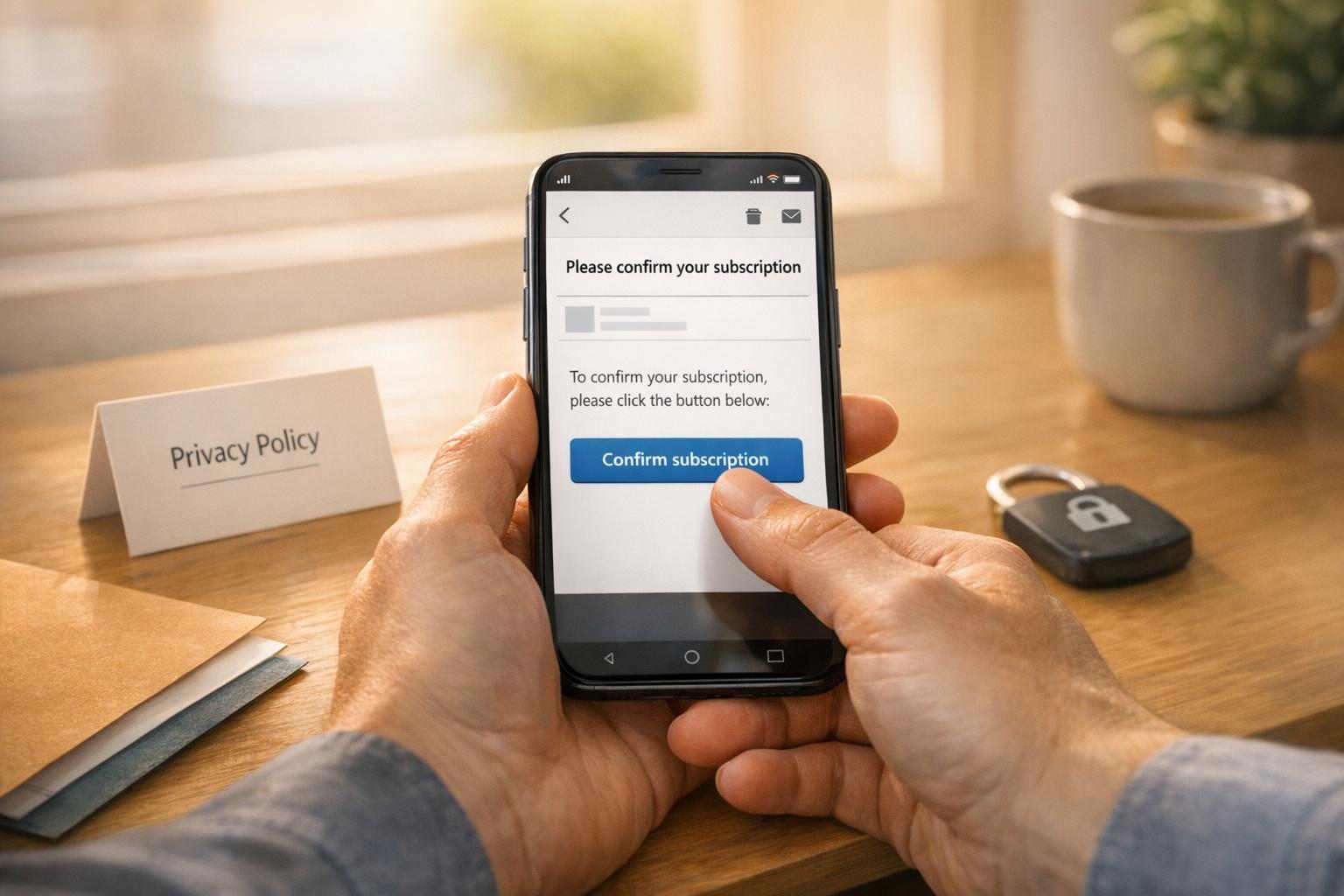
Building trust with donors starts with ethical email list practices. The foundation of this approach is obtaining explicit consent. A double opt-in process is key: subscribers sign up through a form and then confirm their intent by clicking a link in a follow-up email. This ensures that only genuinely interested individuals join your list and helps avoid bot-driven sign-ups. Avoid using pre-checked boxes on donation forms - donors should actively choose to join your list.
For compliance, maintain thorough records of consent. Track details like the date and time of sign-up (in UTC), the channel used (e.g., website form or event sign-up sheet), and the subscriber's IP address. These records can be crucial if your practices are ever questioned. To further protect your database, incorporate CAPTCHA or ReCAPTCHA into online forms to block automated attacks.
Use Double Opt-In and Track Consent
A structured double opt-in process adds another layer of integrity. After someone fills out a sign-up form, they receive an email with a confirmation link. Clicking this link activates their subscription, filtering out mistyped emails, bots, and those who aren't fully interested. This also creates a verifiable consent trail.
Store these consent records securely, including timestamps, IP addresses, and source information. Make it easy for subscribers to leave by including a one-click unsubscribe link in every email and honoring removal requests within 10 business days. Additionally, remind subscribers in email footers about how and where they signed up.
Write Clear Privacy Policies
A clear and accessible privacy policy builds trust. It should explain what data you collect, why you need it, and how it’s used. Use plain language to ensure all donors understand. Your policy should go beyond legal jargon and act as a tool for transparency.
Be specific about email practices: explain how unsubscribes are processed, how long data is retained, and whether you use tracking pixels for analytics. For example, the American Red Cross updated its privacy policy in 2018 to include clear opt-in checkboxes, which improved donor trust scores.
Always provide easy access to your privacy policy. Include links in email footers, on your website, and on physical donor materials like envelopes. Let donors know how to request data deletion or review, while clarifying that some records may need to be retained (e.g., suppression lists to avoid accidental re-contact). Update your policy at least once or twice a year to reflect changes in data laws or internal practices.
Protect Donor Data with Security Measures
Transparency is important, but it must be paired with robust security measures. Use SSL/TLS (HTTPS) to encrypt data during transmission and store sensitive information in encrypted databases instead of plain text. Add an extra layer of protection with multi-factor authentication (MFA). Despite its importance, 56% of nonprofits still don’t use MFA, and 90% of passwords in the sector are weak and vulnerable to hacking.
Role-based access controls can further safeguard donor data. Only employees who need specific information for their roles should have access to it. In 2022, the American Cancer Society implemented a data storage policy that used automated systems to delete outdated data. This reduced stored data by 40% and cut storage costs by $50,000 annually.
Minimize data collection by only asking for necessary information. For example, The Nature Conservancy reduced its donor form fields from 15 to 8, eliminating birth dates. This change led to a 30% increase in form completions and a 25% drop in privacy complaints.
To secure email communications, set up authentication protocols like SPF, DKIM, and DMARC. These verify that emails come from your domain and help prevent spoofing. Use PCI-DSS–compliant third-party services with signed Data Processing Agreements to handle sensitive data responsibly.
| Security Measure | Function | Key Benefit |
|---|---|---|
| Multi-Factor Authentication | Requires two or more forms of verification | Prevents unauthorized access |
| Role-Based Access | Limits permissions to job-specific needs | Reduces exposure to sensitive data |
| Encryption (SSL/TLS) | Secures data during transmission | Prevents interception of sensitive info |
| Regular Access Reviews | Updates user permissions periodically | Removes access for former employees |
How Share Services Supports Ethical Email Marketing
Ethical email marketing requires expertise, and that's where Share Services steps in. They collaborate with nonprofits earning between $1 million and $20 million annually, helping them design privacy-conscious email campaigns. Importantly, these nonprofits retain full control over their fundraising channels and donor relationships, ensuring transparency and trust remain central to their efforts.
Customized Solutions for Nonprofits
Share Services takes a minimalistic approach to data collection - focusing only on essential donor information. This approach reduces privacy risks, aligning with ethical standards. They also implement double opt-in processes to ensure donors provide explicit consent, reinforcing trust at every step.
Their offerings include two main service plans:
- Strategy Retainer ($3,500/month): Includes weekly strategy sessions, project management, and KPI reporting. This plan uses privacy-conscious tracking to evaluate campaign performance.
- Monthly Project Budget ($3,000/month): Covers donor programs, email marketing, branding, and the creation of compliance-friendly content.
Services That Protect Donor Privacy
Share Services goes beyond strategy by focusing on privacy-protective metrics and controlled donor engagement. Instead of traditional open rates, they emphasize List Growth Rate, CTR, and Conversion Rate to measure the success of ethical practices. This shift reflects the importance of trust, as 70% of donors cite trust as a key factor before donating.
For nonprofits looking to expand their reach, the Paid Media Spend plan ($1,500/month) offers targeted campaigns on platforms like Meta, OTT services, and Google Ad Grants. These campaigns prioritize donor acquisition while respecting privacy standards. Across all three service tiers, Share Services employs tools like consent management systems, automated compliance features, and preference centers. These tools empower donors to set their communication preferences, including frequency and topics, ensuring their voices are heard.
How to Measure the Results of Ethical Email Practices
Tracking the impact of ethical email practices means focusing on how your privacy-first approach builds trust and drives donor engagement. These metrics not only highlight campaign effectiveness but also reveal the strength of your ethical email strategies and donor relationships.
Metrics to Track
When it comes to email campaigns, engagement matters more than sheer volume. A smaller, engaged list often outperforms a larger, inactive one. For nonprofits, the average email open rate is around 28.59%. However, privacy updates like Apple’s Mail Privacy Protection have made open rates less reliable. Jonathan Sills, VP of Digital & New Media Strategy at TrueSense, emphasizes:
"Unreliable email OR [open rate] data can help nonprofit marketers focus more on deliverability, click-through, and conversion rates. Paying attention to list hygiene, content personalization, and offer should have been key KPIs of your email program all along".
Instead of fixating on open rates, prioritize metrics like click-through rate (CTR), which averages 3.29% and serves as a dependable measure of engagement. Conversion rates, averaging 1.7%, show how many recipients act after clicking. Keep an eye on unsubscribe rates (0.18%–0.19%) and bounce rates (1.09%–1.72%) to assess list health and content relevance. Another critical metric is revenue per contact, which averages $1.11 for nonprofits but can climb to $6.15 for smaller organizations.
To maintain these results and ensure data quality, regular audits are essential.
Regular Data Audits for Improvement
Frequent audits help improve deliverability and identify potential privacy concerns. For example, removing hard bounces promptly and unsubscribing addresses that soft bounce three times can protect your sender reputation. In 2022, the American Red Cross introduced monthly database audits and error-fixing software, which allowed them to update 10,000 outdated records. This boosted their email delivery rates by 15% and led to an 8% revenue increase during their year-end campaign, showcasing the importance of ethical data practices.
To keep your database in top shape, establish a consistent cleaning routine. This might include monthly duplicate removal, weekly contact updates, and quarterly checks for standardization. The Alzheimer’s Association offers a great example: during a 2022 privacy review led by Data Officer Sarah Lee, they discovered they were retaining donor birthdates longer than necessary. By updating their database to delete this data after two years, they reduced their sensitive data volume by 30%, further safeguarding donor privacy.
For precise improvements, test one variable at a time - like adjusting send times or tweaking CTA styles - to measure the impact of each change.
Conclusion
Protecting donor privacy isn’t just about following the law - it’s about building trust, which is at the heart of every nonprofit’s mission. When donors feel confident their personal information is safe and handled with care, they’re more likely to give generously and stay connected over time. Clear consent practices and open communication are key to fostering these strong relationships.
Ethical practices lay the groundwork for effective donor engagement. By focusing on transparency, security, and respect, nonprofits can improve both trust and outcomes. For example, writing privacy policies in straightforward, easy-to-understand language ensures donors know exactly how their information is used. Limiting data collection to only what’s absolutely necessary can boost both donor engagement and completion rates for forms. On top of that, adopting strong security measures - like encryption and multi-factor authentication - is critical, especially considering that 90% of passwords used by nonprofits are weak and vulnerable to hacking.
Training your team and leveraging technology go hand in hand when it comes to safeguarding donor data. Nonprofits that educate their staff on security protocols and simplify privacy policies are less likely to face data breaches and more likely to retain donors. This approach reinforces the principles of transparency, security, and respect. As Dustin Radtke, CEO of Momentive Software, explains:
"Donor trust and nonprofit control over fundraising aren't negotiable principles in the mission-driven industry. They're the foundation of everything we do".
Regular audits and consistent data cleaning are essential for staying on top of privacy practices and maintaining strong donor relationships. By treating donor information as the priceless asset it is, nonprofits not only mitigate risks but also set the stage for long-term success. Every step you take to protect donor data sends a powerful message: your supporters are valued partners, not just contributors.
For nonprofits with annual revenue between $1M and $20M aiming to enhance their digital fundraising while adhering to ethical standards, Share Services (https://shareservices.co) offers tailored solutions designed to prioritize donor privacy and build lasting trust.
FAQs
What donor data should we avoid collecting?
Nonprofits should be cautious about collecting personal information that isn't directly tied to their relationship with donors. Avoid gathering details like extensive financial or health data unless donors have clearly given their consent or it's required by law. Sticking to essential information not only safeguards donor privacy but also strengthens trust between the organization and its supporters.
How can we prove donor consent during an audit?
To demonstrate donor consent during an audit, maintain detailed records showing when and how consent was given. This could include signed opt-in forms or electronic records. It's crucial to ensure that donors were clearly informed about how their data would be used - especially if it involves sharing or trading lists - and that their consent was both explicit and aligned with privacy laws.
What email metrics still matter when open rates are unreliable?
When open rates aren't the most reliable metric, shift your attention to other indicators like click-to-open rates, user engagement, and action tracking - things like clicks, conversions, and ongoing interactions. These metrics paint a more accurate picture of how supporters are engaging with your campaigns. By focusing on these, you can better understand donor behavior, strengthen relationships, and ensure your strategies match what truly interests them.
Related Blog Posts
Get helpful resources, straight to your inbox
We love sharing tools, ideas, and stories that make nonprofit work a little lighter and a lot more effective. Sign up below and we’ll send you practical tips, free resources, and a bit of encouragement—because the work you’re doing matters.
No spam. Just good stuff for good people.